

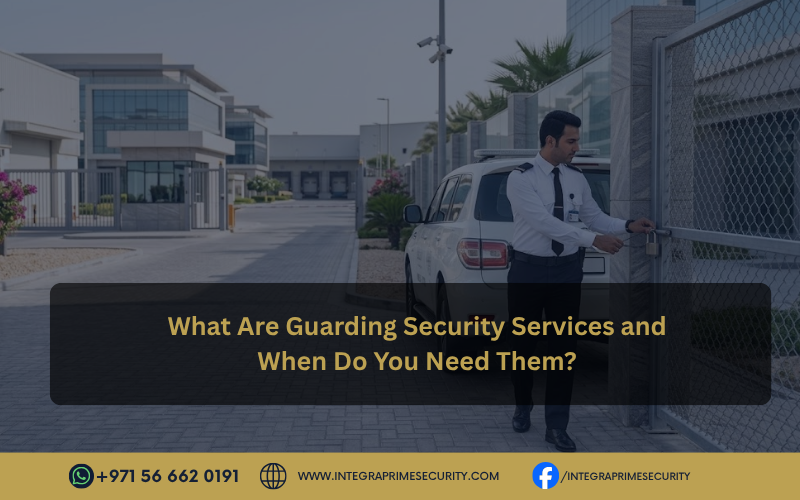
Guarding security services involve deploying trained security personnel to protect people, property, buildings and business operations from potential security threats. In the UAE, businesses use professional security guards to manage access, monitor premises, deter unauthorised activity, respond to incidents and maintain a safe environment for employees, visitors and customers.
From commercial offices and residential developments to warehouses, hotels, retail premises and construction sites, the need for physical security depends on the nature of the property, its daily operations and the risks it faces.
However, hiring security personnel is not simply about having someone stand at an entrance. Effective guarding requires clear responsibilities, appropriate deployment, communication procedures and an understanding of the environment being protected.
This guide explains what guarding security services include, how they work, the different types of security guarding available, and when a business or property owner in the UAE should consider professional protection.
Guarding security services are professional security arrangements involving personnel who are assigned to protect specific premises, individuals or activities. Their primary purpose is to prevent security incidents, identify potential risks and take appropriate action when something unusual happens.
Unlike security systems that rely mainly on cameras, alarms and electronic equipment, physical guarding provides a visible human presence. Security officers can observe their surroundings, communicate with people, check access permissions and respond to situations that require immediate attention.
Depending on the assignment, guarding responsibilities may include:
The duties assigned to an officer should reflect the property’s security requirements rather than follow a generic approach.
For example, a security officer working at a corporate office may spend much of the shift managing reception access and checking visitors. At a warehouse, the focus may be on vehicle movements, loading areas, perimeter security and preventing unauthorised access to restricted storage areas.
Businesses looking for professional guarding security services can benefit from an arrangement designed around their premises, operational activities and identified security risks.
Security risks can affect businesses in different ways. Unauthorised entry, theft, vandalism, disputes, property damage and disruption to daily operations can create financial and operational problems.
A professional security presence helps businesses manage these risks through observation, access management and preventive security measures.
One of the main responsibilities of a security officer is to control who enters and leaves a property.
Without appropriate access management, people may enter restricted areas without permission, potentially exposing employees, equipment, confidential information and valuable assets to unnecessary risks.
Security guards can:
This is particularly useful for offices, industrial facilities, residential developments and commercial buildings.
Commercial properties often contain valuable equipment, machinery, stock, vehicles and other assets.
Security officers help protect these resources by monitoring vulnerable areas, conducting patrols and identifying unusual activity.
For example, a warehouse may require additional attention around loading bays, storage areas and vehicle entrances, while a retail property may need monitoring around stockrooms and customer access points.
Security personnel can contribute to a safer environment by identifying potential hazards, managing disturbances and reporting incidents.
They may also support emergency procedures, including alerting relevant emergency services, assisting with evacuations and directing people away from unsafe areas.
Security guards should understand their responsibilities and work within the boundaries of their training, authority and site instructions.
A uniformed security officer can act as a visible deterrent to individuals considering unauthorised access, vandalism or other disruptive behaviour.
The presence of personnel also gives employees, residents and visitors a designated point of contact when they need assistance.
However, visibility alone does not guarantee protection. Effective security depends on appropriate positioning, professional conduct, communication and consistent supervision.
The type of guarding required depends on the property, operating hours, number of access points and potential threats.
Some businesses need an officer at a fixed entrance, while others require mobile patrols or a combination of different guarding arrangements.
Typical responsibilities include:
Static guarding is commonly suitable for corporate offices, commercial buildings, residential developments, retail premises and facilities with controlled entry points.
Patrols may cover:
This arrangement helps improve visibility across larger properties where monitoring every location from a single post would be difficult.
For properties with contractors, suppliers, delivery drivers and visitors, these procedures help maintain better oversight of who is present.
Security personnel may verify identification, check visitor permissions, maintain entry records and coordinate with reception or site management.
Events can introduce additional security challenges because large numbers of people may enter a venue within a short period.
Event guarding may involve:
The number of officers and their positioning should be based on the venue, expected attendance, event activities and assessed risks.
Residential security guarding helps manage access to apartment buildings, residential communities and other managed properties.
Typical responsibilities include monitoring entrances, recording visitors, observing communal areas and reporting maintenance or safety concerns to the appropriate property representatives.
Security personnel may also help residents and visitors with basic directions and access-related enquiries.
Construction sites and industrial facilities may contain expensive equipment, materials, machinery and areas that present safety risks.
Security officers can help protect these environments through access checks, vehicle monitoring, perimeter patrols and reporting suspicious activity.
Site-specific instructions are particularly important because security personnel must understand which areas are restricted and how to respond to incidents without interfering with operational or safety procedures.
Not every property requires the same level of security. The decision should be based on an assessment of the premises, its activities and the potential consequences of a security incident.
There are several situations where professional guarding may be particularly beneficial.
Buildings with several entrances, loading bays, vehicle gates or pedestrian access points can be difficult to monitor without dedicated personnel.
Security officers can be positioned at important locations to check access permissions and report unusual movements.
Warehouses, distribution centres, retail premises and industrial facilities may hold valuable assets that need protection outside normal operating hours.
Guarding can provide a visible presence and help monitor vulnerable areas during evenings, weekends and other quieter periods.
Facilities operating 24 hours a day may experience different security requirements across morning, afternoon and overnight shifts.
An appropriate guarding arrangement can maintain security coverage during periods when management, administrative staff or other employees are not present.
Property managers are responsible for maintaining an orderly and secure environment for occupants, visitors, contractors and service providers.
Security personnel can support these responsibilities by monitoring access, reporting incidents and following building-specific procedures.
Previous incidents, repeated unauthorised entry attempts, vandalism or unexplained property damage may indicate that existing security arrangements need reviewing.
A professional assessment can help identify vulnerable areas and determine whether additional guarding, improved access procedures or other protective measures are appropriate.
Events can create temporary security requirements that differ from those of a property’s normal operations.
Additional personnel may be needed to manage access, monitor crowd movement and protect designated areas throughout the event.
The responsibilities of a security guard extend beyond standing at an entrance or watching a property.
Officers are expected to remain observant, communicate professionally and follow the instructions established for their assignment.
Although duties vary by location and role, common responsibilities include the following.
Security guards observe their assigned surroundings to identify unusual behaviour, potential hazards and security concerns.
They may also monitor approved CCTV systems where this forms part of their assigned duties and authorisations.
Officers help ensure that only authorised individuals enter designated areas. This may involve checking identification, recording visitor details and following site-specific access procedures.
Accurate reporting allows management to understand what happened, when it happened and what action was taken.
Incident reports may cover attempted unauthorised access, property damage, disturbances, safety concerns and other relevant events.
Security personnel may be among the first people to identify an emergency.
Their responsibilities can include raising the alarm, contacting emergency services, following evacuation procedures and communicating important information to the relevant people.
Security officers need to communicate effectively with supervisors, property managers, reception teams and other authorised personnel.
Clear communication is especially important during shift changes, incidents and situations requiring additional assistance.
Businesses can gain a better understanding of these duties through an explanation of What are Roles, Responsibilities & Duties for Security Guards?
The UAE has a regulated private security sector. Businesses arranging security protection should understand the relevant licensing requirements and ensure that their chosen provider is authorised to deliver the required services.
At the federal level, Federal Law No. 37 of 2006 concerning Private Security Companies establishes requirements for private security companies and their activities.
The legislation addresses matters including security approvals, company licensing, security personnel and the permitted scope of security operations. It also establishes that a company’s activities are generally restricted to the emirate in which it is licensed, subject to the applicable exceptions and requirements.
In Dubai, the Security Industry Regulatory Agency (SIRA) regulates the security industry.
Under Dubai Law No. 12 of 2016, security service providers must obtain the relevant licence before providing security services in the emirate.
Dubai’s implementing regulations also establish requirements for security companies and individual security personnel. These include applicable qualifications, approvals and licensing conditions. Dubai Leadership Portal+1
Businesses arranging security guarding in Dubai should therefore check that the provider holds the appropriate authorisation for the services being supplied.
SIRA provides official services for security activity licensing and individual security personnel licensing.
Security licensing and operational requirements should not be assumed to be identical across all seven emirates.
The applicable competent authority and requirements must be checked for the emirate where the service will be delivered.
A company operating in Dubai should not automatically be assumed to have permission to provide the same security services in Abu Dhabi, Sharjah or another emirate.
For this reason, businesses should confirm the provider’s licensing position, approved activities and geographical scope before entering into a security services agreement.
Selecting a security provider requires more than comparing quotations. The quality of the service depends on the provider’s ability to understand your requirements, deploy suitable personnel and maintain consistent operational standards.
Consider the following factors before making a decision.
Confirm that the company is legally authorised to provide the relevant security services in the emirate where your premises are located.
In Dubai, check the relevant SIRA authorisations and ensure that the service being offered falls within the provider’s licensed activities.
Ask how the provider will arrange personnel for your property.
Important questions include:
The answers should demonstrate that the company can manage the assignment consistently.
Security personnel should have the qualifications, approvals and competencies required for their specific roles.
Consider whether officers understand access control, incident reporting, communication, emergency procedures and customer-facing responsibilities relevant to your site.
A security contract should establish how the provider monitors service delivery.
Ask about:
These arrangements help ensure that security requirements remain clear after deployment.
Two quotations may appear similar but include different levels of coverage.
One provider may include a dedicated supervisor, while another may quote only for security officers. Working hours, staffing arrangements, equipment and reporting responsibilities can also affect the overall cost.
Compare the actual scope of service before making a decision.
Before arranging guarding services, businesses should identify what they expect security personnel to achieve.
A clear brief helps the provider recommend an appropriate deployment rather than offering a standard arrangement that may not address the property’s actual risks.
Use this checklist when preparing your requirements:
You should also establish whether the assignment requires additional security arrangements, such as approved CCTV monitoring or electronic access control.
Physical guarding and electronic security can complement each other, but they should be selected according to the property’s actual requirements.
Static guarding involves assigning an officer to a specific location, such as a building entrance or reception area. Mobile patrols involve security personnel moving around designated areas to inspect different parts of a property. The appropriate option depends on the property’s size, layout and security requirements.
Small businesses may benefit from professional guarding if they have valuable equipment, customer-facing premises, restricted areas or security concerns. The decision should be based on a risk assessment rather than business size alone.
Yes. Security guarding arrangements can be designed to cover overnight operations, weekends and continuous shifts, subject to applicable licensing and employment requirements. Businesses should establish suitable staffing, shift handovers and supervisory arrangements to maintain consistent coverage.
Yes. Private security companies are subject to federal legislation and applicable emirate-level requirements. In Dubai, SIRA regulates the security industry and issues relevant licences to security service providers. Businesses should verify that their chosen provider is authorised to deliver the required services in the relevant emirate.
There is no universal number of security guards suitable for every commercial property. The requirement depends on the property’s size, number of access points, operating hours, risk exposure and required responsibilities. A security assessment can help establish an appropriate staffing arrangement.
Yes. Depending on their assigned duties and training, security officers can manage visitor access while monitoring the surrounding premises. This is common in offices, residential developments, hotels and commercial buildings where access management and general property protection are both required.
How can we help you?
WhatsApp us