

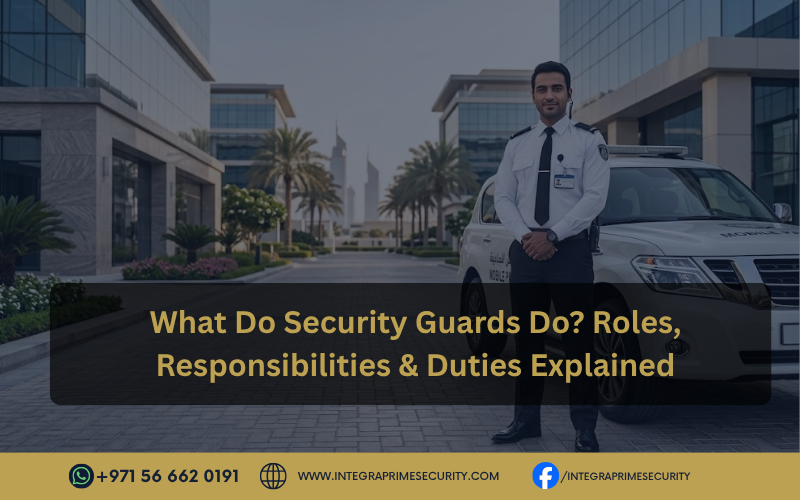
Security guards play an important role in protecting people, property, assets and business operations. From monitoring entrances and checking visitor credentials to responding to incidents and maintaining security records, their duties extend far beyond simply standing at a gate or patrolling a building.
In the UAE, security guards work across a wide range of environments, including commercial offices, residential towers, shopping malls, hotels, warehouses, construction sites and events. Their responsibilities depend on the type of premises, the risks involved and the instructions provided by their employer or security service provider.
Understanding what security guards do helps business owners choose the right level of protection and helps individuals understand the expectations of the profession. This guide explains the main security guard duties, daily responsibilities, required skills and the regulatory considerations businesses should know when arranging security services in the UAE.
The main role of a security guard is to help prevent security incidents, protect people and property, identify potential risks and respond appropriately when something goes wrong.
A guard provides a visible security presence while carrying out practical tasks designed to reduce opportunities for theft, unauthorised access, vandalism, disruption and other incidents.
Typical responsibilities include:
The exact duties vary from one site to another. A security guard working in a residential tower may spend much of the shift managing visitors and deliveries, while a warehouse guard may focus on vehicle movements, loading areas and stock protection.
Businesses should therefore define their security requirements before appointing a provider. Understanding the different responsibilities of guards security professionals can help decision-makers assess which duties need to be covered at their premises.
Although every site has its own operating procedures, most security guarding assignments involve several core responsibilities.
Access control is one of the most common security guard duties. It involves managing who enters and leaves a building or site.
A guard may be responsible for:
For example, at an office building in Dubai, a guard may verify a visitor’s appointment before allowing access beyond the reception area. At a warehouse, the guard may check delivery documentation and confirm that a vehicle is expected before permitting entry.
Access control should be carried out consistently and professionally. Guards must follow the site’s authorised procedures, respect privacy and avoid making decisions outside their responsibilities.
Security patrols help guards identify potential problems that may not be visible from a fixed post.
Depending on the assignment, patrol duties may include checking:
During a patrol, a guard may discover an unsecured door, damaged fencing, an unattended package or an obstruction affecting an emergency exit. The appropriate response is to assess the situation safely, follow site procedures and report the issue to the relevant person.
Patrol frequency and routes should reflect the site’s risk assessment and operating requirements rather than follow an arbitrary schedule.
Where CCTV monitoring forms part of the assignment, security personnel may observe camera feeds, monitor alarms and report unusual activity.
Their responsibilities can include:
CCTV is most effective when supported by clear operating procedures and appropriate human oversight. A camera may show an incident developing, but someone must interpret the information and ensure the concern reaches the right person.
Not every security guard operates CCTV equipment. Some positions focus primarily on physical guarding, while others are specifically assigned to control rooms or security operations centres.
Security guards help reduce opportunities for theft, damage, vandalism and unauthorised removal of business assets.
At commercial premises, this may involve monitoring storage areas, observing deliveries, checking authorised movements of equipment and reporting discrepancies.
For warehouses and distribution facilities, guards may be instructed to verify vehicle details, maintain entry and exit records, follow goods-movement procedures and alert supervisors to irregularities.
Their role is to follow approved checks and report concerns. They should not assume that every discrepancy indicates wrongdoing or take enforcement action beyond their authority.
Security guards also help maintain an orderly environment for employees, customers, residents and visitors.
Common tasks include directing people, managing queues, addressing minor disturbances calmly and contacting supervisors when a situation becomes difficult to manage.
In a hotel, shopping mall or residential development, the way a guard communicates can influence how visitors experience the premises. Professional conduct, clear instructions and a respectful manner are therefore important parts of the role.
When an incident occurs, a security guard must remain calm, assess the situation and follow the site’s emergency procedures.
Depending on the circumstances, responsibilities may include:
Incidents may include fire alarms, medical emergencies, attempted unauthorised entry, property damage or disturbances involving visitors.
Security guards are not automatically qualified firefighters, medical professionals or law enforcement officers. They should act within their training, avoid unnecessary risks and seek specialist assistance when needed.
Accurate reporting is another essential responsibility. Security records help site managers understand incidents, identify recurring problems and review whether existing security procedures are effective.
A guard may need to record:
Reports should distinguish between direct observations and information provided by other people. Clear, factual records are more useful than assumptions or emotionally worded descriptions.
Guards must also handle confidential information responsibly and follow the organisation’s recordkeeping and data protection procedures.
Security operations often run across multiple shifts. A proper handover ensures that important information is not lost when one guard finishes duty and another takes over.
A handover may cover outstanding incidents, maintenance concerns, temporary access arrangements, expected visitors, equipment faults and instructions issued by site management.
Good communication between guards, supervisors, reception teams and facilities managers helps maintain consistent protection throughout the day and night.
The environment determines which responsibilities deserve the most attention. A security plan for a hotel will differ from one designed for an industrial facility or a construction site.
Commercial offices and corporate buildings
Guards manage visitor access, monitor entrances, direct contractors, patrol common areas and report suspicious activity. They may also coordinate with reception and facilities teams.
Shopping malls and retail premises
Responsibilities can include monitoring public areas, supporting queue management, observing potential theft, assisting visitors and escalating disturbances to the appropriate team.
Hotels and hospitality venues
Guards help control access to staff-only areas, monitor entrances, respond to guest concerns and coordinate with hotel management while maintaining a welcoming atmosphere.
Warehouses and logistics facilities
Typical duties include checking vehicle authorisation, recording deliveries and departures, monitoring loading bays and reporting irregularities involving stock or equipment.
Construction sites
Guards may check worker and contractor access, monitor site boundaries, record vehicle movements and report unauthorised entry or unsafe conditions to the responsible site team.
Residential buildings and communities
Duties often involve visitor registration, access management, common-area patrols, delivery coordination and reporting maintenance or security concerns to building management.
These examples illustrate typical assignments rather than a universal duty list. A business should tailor its security instructions to its premises, operating hours, access arrangements and identified risks.
Performing security duties requires more than physical presence. Guards need sound judgement, consistent attention and the ability to communicate effectively with different people.
Key skills include:
Physical fitness may also be relevant where a role involves extended standing or regular patrols. The specific requirements depend on the assignment.
Security guard licensing in the UAE must be understood in the context of the emirate and the type of security activity.
In Dubai, the Security Industry Regulatory Agency (SIRA) regulates the security industry under the applicable Dubai legislation. Dubai’s Law No. 12 of 2016 and its implementing regulations establish licensing requirements for security service providers and personnel. SIRA also administers the relevant security personnel licensing processes.
Businesses arranging guarding services in Dubai should check that the provider holds the appropriate licence and that personnel have the authorisation required for their assigned roles. The specific requirements depend on the security activity and applicable rules.
The wider UAE also has a federal legal framework governing private security companies, alongside relevant emirate-level requirements. A business should not assume that a licence or approval applicable in one emirate automatically authorises every security activity in another.
Before appointing a security provider, businesses should verify:
Requirements can change, so confirm current details directly with the relevant authority. For Dubai, consult the official Security Industry Regulatory Agency (SIRA) website at sira.gov.ae.
Professional security guards must understand the limits of their authority. Their role is to protect people and property, follow lawful instructions and report incidents—not to act as though they have unlimited police powers.
| Security guards should | Security guards should not |
| Follow approved site procedures | Ignore instructions or bypass access controls |
| Report suspicious activity factually | Treat suspicion alone as proof of wrongdoing |
| Communicate calmly during disputes | Use unnecessary force or intimidation |
| Protect confidential information | Share personal or security information without authorisation |
| Escalate serious incidents promptly | Attempt dangerous interventions beyond their training |
| Record incidents accurately | Alter records or make unsupported accusations |
| Follow emergency plans | Block emergency exits or create additional hazards |
Any intervention must comply with applicable law, the guard’s training and the circumstances. Questions involving detention, searches, use of force or personal data require particular care and should be addressed through the applicable legal framework and approved procedures.
Hiring security personnel is only one part of a successful security arrangement. Guards need clear instructions, suitable supervision and the resources required to carry out their duties.
Businesses in the UAE can improve security operations by taking the following steps.
Identify the people, property, equipment and operations that need protection. Consider access points, operating hours, visitor volumes, vulnerable areas and the consequences of a security incident.
Specify which entrances need coverage, when patrols should take place, how visitors are registered and who must be contacted when an incident occurs. Clear instructions reduce confusion and inconsistent decisions.
Guards should know how to contact supervisors, facilities managers and emergency services. They should also understand which issues require immediate escalation and which can be recorded for routine follow-up.
Supervisors can review reports, check compliance with site instructions, identify recurring problems and address performance concerns. Regular communication also helps management respond when site conditions change.
Businesses should periodically review incident reports, access records, identified vulnerabilities and feedback from site management. Changes in building use, staffing, operating hours or risk levels may require adjustments to the guarding arrangement.
For organisations considering professional protection, understanding What Is Security Guarding? A Complete Guide for UAE Businesses provides a useful starting point for evaluating how guarding fits into a wider site security plan.
The main duties include controlling access, patrolling premises, monitoring security systems where required, protecting people and property, responding to incidents, maintaining records and reporting security concerns. Exact responsibilities depend on the site and assigned role.
Security personnel must meet the applicable licensing and authorisation requirements for their role and location. In Dubai, SIRA oversees relevant private security licensing arrangements. Businesses should verify current requirements with the competent authority before assigning security duties.
Security guards do not have the general police powers of law enforcement officers. Any intervention, detention or other action must be assessed under applicable law and the circumstances. Guards should follow approved procedures and contact the appropriate authorities when necessary.
A security guard generally performs frontline duties such as access control, patrols and incident reporting. A security supervisor typically coordinates personnel, checks compliance with site instructions, supports incident management and reports operational issues to management. Actual responsibilities depend on the organisation.
Yes, if CCTV monitoring is included in their assigned role and they have the appropriate training and authorisation. Some guards monitor cameras alongside other duties, while dedicated control-room personnel focus on surveillance, alarms and communication.
There is no single number suitable for every business. Staffing depends on the size and layout of the premises, number of access points, operating hours, identified risks, visitor volumes and required coverage. A site-specific risk assessment can help determine the appropriate arrangement.
How can we help you?
WhatsApp us