

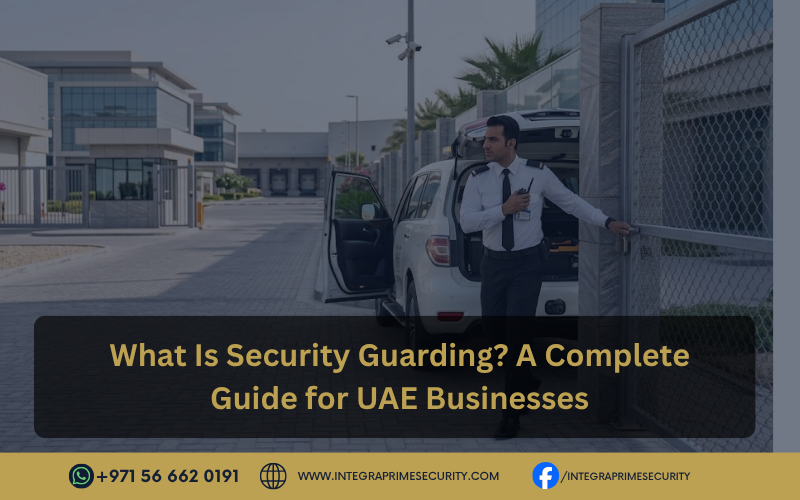
Security guarding is the use of trained security personnel to protect people, property, premises and business operations from potential security threats. For businesses in the United Arab Emirates (UAE), professional guarding can help manage access to buildings, deter unauthorised activity, respond to incidents and maintain a safe environment for employees, customers and visitors.
From commercial offices and retail outlets to residential developments, warehouses and construction sites, security requirements vary according to the property, its daily activities and the risks it faces.
Understanding how security guarding works helps business owners, facilities managers and property operators choose an appropriate level of protection. This guide explains the main types of guarding, the responsibilities of security guards, the benefits for UAE businesses, relevant regulatory considerations and how to select a suitable security provider.
Security guarding is a protective service in which security personnel monitor a location, control access where authorised, observe potential risks and take appropriate action when incidents occur.
Unlike security equipment that records or detects activity, a security guard can assess a situation in real time, communicate with people on site and follow established procedures when something unusual happens.
Professional security guarding is commonly used to support several objectives:
The precise duties depend on the assignment, the security provider’s authorised activities, site procedures and applicable regulations. A guard’s role is to provide security within the limits of their authority, not to replace the police or other emergency services.
Businesses operate in different environments, each with its own security challenges. A retail shop may need to monitor customer activity and protect stock, while an industrial warehouse may need tighter control over vehicle movements, loading areas and restricted spaces.
In the UAE, commercial offices, shopping centres, hotels, residential communities, logistics facilities and construction projects may all require different approaches to security.
Security personnel help businesses protect employees, customers, visitors, equipment, inventory and physical premises. Their presence can support a more controlled environment, particularly in buildings with frequent visitors or valuable assets.
For example, a warehouse security guard may verify delivery details and monitor vehicle entry, while a guard at a commercial reception area may direct visitors through an established registration process.
Uncontrolled entry can expose a business to theft, disruption, information security risks and safety concerns. Guards can check access permissions, maintain visitor records where required and direct unauthorised individuals to the appropriate contact.
Access procedures should be clear, consistent and appropriate to the site’s needs. Security personnel should also understand how to respond when a visitor refuses to follow the procedure or when an access credential cannot be verified.
Security incidents can interrupt operations, delay deliveries or require parts of a building to close. Patrols, incident reporting and clear escalation procedures can help businesses identify problems early and coordinate an appropriate response.
Guarding cannot eliminate every risk, but it can form an important part of a wider business continuity and risk management plan.
A professional, approachable security presence can make employees, customers, tenants and visitors feel more comfortable. This is particularly relevant in buildings that receive visitors throughout the day or operate outside conventional office hours.
The quality of this experience depends on communication, professionalism and the guard’s ability to balance security procedures with helpful customer service.
Security guarding can be organised in several ways. The appropriate arrangement depends on the property’s layout, operating hours, expected visitor numbers and assessed risks.
Static guarding involves assigning a security officer to a designated position, such as a building entrance, reception desk, gatehouse or security post.
Typical responsibilities may include:
Static guarding is often suitable for office buildings, residential entrances, commercial premises and facilities where a consistent security presence is required at a particular location.
Mobile patrols involve security personnel moving around a site or visiting designated locations according to an agreed schedule.
Patrols may cover perimeter fencing, parking areas, service entrances, storage spaces and other locations that require regular observation.
This approach can help identify unsecured doors, unusual activity, visible damage or other concerns that may not be apparent from a fixed security post.
Large warehouses, construction projects and commercial properties with extensive external areas may benefit from patrol-based arrangements. The patrol frequency and coverage should reflect the site’s risk assessment rather than an arbitrary schedule.
Reception security combines protective responsibilities with visitor management and customer service.
Depending on the assignment, personnel may greet visitors, confirm appointments, issue visitor passes, contact employees and monitor the entrance area. They may also help maintain orderly access during busy periods.
This arrangement is particularly relevant to corporate offices, business centres, hotels and multi-tenant commercial buildings.
Construction sites can contain expensive equipment, building materials, fuel, temporary structures and areas that are unsafe for unauthorised visitors.
Security guarding may include checking contractor access, monitoring deliveries, conducting perimeter patrols and reporting damaged fencing or unsecured storage areas.
A suitable plan should consider changing site layouts, different working hours, delivery schedules and periods when valuable equipment remains unattended.
Events require security arrangements that reflect the venue, expected attendance, event activities and crowd-management risks.
Depending on their assigned duties and applicable approvals, security personnel may help manage entry queues, check admission permissions, direct visitors, monitor designated areas and report incidents to event management.
Organisers should establish clear responsibilities between security personnel, venue management, event staff and emergency responders before the event begins.
Residential guarding supports controlled access and security monitoring in apartment buildings, residential compounds and other managed communities.
Duties may include visitor registration, contractor access checks, patrols of shared areas and reporting maintenance or security concerns to the property management team.
The procedures should protect residents’ privacy while maintaining appropriate oversight of common entrances and shared facilities.
A security guard’s daily responsibilities are shaped by the assignment, the agreed service scope and the rules governing their work. However, several duties are common across many commercial environments.
Guards may verify visitor appointments, check identification when required by site procedures, confirm contractor permissions and maintain entry records. They should know how to handle exceptions and whom to contact when authorisation is unclear.
Patrol duties involve checking designated areas, observing unusual activity and reporting issues such as damaged locks, open access points or potential safety hazards.
A useful patrol process identifies where the guard should go, what they should check and how any findings should be recorded.
Where the assignment includes CCTV or other security equipment, personnel may observe authorised camera feeds, communicate with colleagues and report suspicious activity. Responsibilities vary according to the equipment, the site’s procedures and the person’s authorised role.
Security guards may need to document incidents involving unauthorised access, disputes, property damage, suspicious behaviour or other concerns.
A good report records relevant facts, times, locations, observations and actions taken. It should distinguish what the guard directly observed from information provided by another person.
When an incident requires police, ambulance or fire service assistance, personnel should follow the site’s emergency procedures and contact the appropriate service without unnecessary delay.
Depending on their training and assigned duties, security personnel may raise alarms, guide people towards designated exits, assist with evacuation procedures and communicate with emergency responders.
They should understand the site’s emergency contacts, assembly points and reporting arrangements. Security guarding does not replace specialist firefighting, medical or emergency response services.
At the end of a shift, guards should communicate outstanding issues, unusual observations, expected visitors, access concerns and any follow-up actions required.
Clear handovers reduce the risk of information being lost between shifts and help supervisors maintain continuity across the site.
Effective guarding starts with understanding the site rather than simply placing a guard at an entrance.
A typical process involves the following stages.
1. Assess the site and its risks. Review the premises, access points, operating hours, assets, visitor activity, previous security concerns and relevant operational requirements.
2. Define the security objectives. Establish what the assignment must achieve. Objectives might include controlled entry, perimeter monitoring, visitor management or protection of a particular area.
3. Agree the duties and coverage. Specify the guard’s post, patrol areas, working hours, reporting arrangements, escalation contacts and handover procedures.
4. Brief the security personnel. Explain site rules, emergency procedures, access permissions, restricted areas and the process for reporting incidents.
5. Deliver and supervise the service. Guards perform their assigned duties while supervisors or designated management contacts oversee service delivery and address operational issues.
6. Review performance. Examine incident records, patrol reports, recurring concerns and feedback from the client. Adjust the arrangement when risks or site operations change.
For example, a business moving into a larger warehouse may introduce additional vehicle access checks and extend patrol coverage to newly used storage areas. The security plan should evolve with the site instead of remaining fixed after the initial deployment.
Security guards and CCTV systems serve related but different purposes. Businesses should assess what each can contribute rather than automatically treating one as a replacement for the other.
| Factor | Security guarding | CCTV surveillance |
| Main function | Physical presence, observation and authorised intervention | Visual monitoring and recording |
| Interaction with people | Can communicate directly with visitors and staff | Usually provides observation rather than direct interaction |
| Incident response | Can assess a situation and follow site procedures | Can help identify or document activity and alert responders when appropriately monitored |
| Coverage | Depends on the guard’s post and patrol area | Depends on camera placement, visibility and system performance |
| Records | Incident reports, access logs and patrol records | Video footage and associated system records |
| Limitations | Human attention, coverage and shift availability are finite | Blind spots, poor visibility, technical faults and monitoring limitations can affect usefulness |
For many premises, combining guards with appropriately designed CCTV, access control and alarm systems provides a more coordinated approach.
However, the right combination depends on the site’s risk assessment, operating requirements, budget and any applicable regulatory conditions. Some facilities may have specific security-system requirements that must be checked separately.
Yes. Private security services are subject to legal and regulatory requirements in the UAE. Businesses should confirm that their chosen security provider and the personnel assigned to their premises meet the requirements applicable to the location and type of service.
The Security Industry Regulatory Agency (SIRA) regulates the security industry in Dubai. Dubai Law No. 12 of 2016 establishes the regulatory framework, while its implementing regulations set out requirements for security service providers and personnel.
Under this framework, security services cannot be provided in Dubai without the relevant licence. Businesses should also check that the provider is authorised for the activities it will undertake. Dubai’s security industry legislation explains the licensing framework.
Other emirates have their own applicable authorities and regulatory arrangements, alongside relevant federal legislation. A business should not assume that checking a Dubai-specific approval alone establishes compliance for every location or activity across the country.
Before entering into an agreement, confirm:
For example, a business operating in Dubai and Abu Dhabi should verify the requirements applicable to each location before arranging security coverage.
Official guidance and legislation should be checked directly because regulatory requirements can change and may differ according to the service and facility.
Selecting a security provider involves more than comparing the number of guards or the quoted hourly rate. Businesses should evaluate the provider’s suitability, operating procedures and ability to meet the site’s actual security needs.
Ask for the relevant company licence and verify that the provider is authorised to deliver the services being proposed. Confirm any applicable personnel approvals and site-specific requirements.
Do not rely solely on marketing statements or an assurance that a company operates throughout the UAE.
A provider familiar with commercial offices may not automatically be the best fit for a construction site or industrial facility. Ask how its proposed procedures address the particular risks, access arrangements and operating conditions of your premises.
The discussion should focus on relevant capabilities rather than unsupported claims about experience or performance.
Ask how guards are selected, briefed and supervised. Find out how the provider manages shift coverage, absences, handovers, refresher training and performance concerns.
The answers should demonstrate a clear operational process rather than relying on the assumption that every guard will independently understand the site’s requirements.
Ask how incidents are reported, who receives escalation notifications and how emergency contacts are reached. Establish how the provider will coordinate with your facilities team and other relevant personnel.
For sites with multiple entrances or large external areas, clarify how guards communicate and how supervisors monitor the assignment.
Before signing, review the contract for details such as:
A written agreement helps both parties understand what is included and reduces the risk of different expectations after deployment.
Security guarding costs vary according to the assignment. There is no single price that applies to every UAE business because staffing requirements, working hours, location and service responsibilities differ.
The main factors include:
Number of guards: A single security post requires a different staffing arrangement from a site with several entrances and patrol zones.
Coverage hours: Extended or continuous coverage requires suitable shift planning and staffing arrangements.
Site complexity: A large warehouse, multi-building development or busy commercial property may require more supervision and coordination than a small office.
Required duties: Visitor management, detailed access checks, patrol reporting and other additional responsibilities can affect the scope of the service.
Equipment and systems: Where the contract includes communication equipment or other security resources, the associated provision and maintenance arrangements may influence the price.
Location and deployment arrangements: Travel, mobilisation, staffing availability and the requirements applicable to the site can affect the overall quotation.
When comparing proposals, businesses should assess the total cost against the actual service offered. A lower quotation may not provide the coverage, supervision or reporting arrangements required for the premises.
Request a written breakdown of staffing, working hours, included services and additional charges before making a decision.
Even when a business hires a security provider, poor planning can limit the effectiveness of the arrangement.
Businesses can reduce these weaknesses by reviewing the service regularly, keeping procedures current and maintaining communication between the security provider and site management.
For a more specific explanation of duties and service arrangements, see What Do Professional Security Guard Services in Dubai Include?. This is particularly relevant when comparing different guarding arrangements for commercial premises.
The main purpose is to protect people, property and premises through a visible security presence, observation, access control, patrols and appropriate incident reporting. The precise responsibilities depend on the assignment and applicable regulations.
Security guarding may be suitable for offices, retail outlets, hotels, warehouses, construction sites, residential communities, industrial facilities and event venues. The level of coverage should depend on the site’s risk assessment and operational needs.
Security guards are not police officers and do not have general police powers. Their authority is limited by applicable law and the circumstances of an incident. Guards should follow their training and procedures, avoid unnecessary confrontation and contact the police when appropriate.
Dubai has a specific regulatory framework administered by SIRA. Security providers and personnel must meet the applicable licensing and other requirements for their roles. Businesses should verify the current requirements for the particular service rather than assume that one approval covers every activity.
CCTV can help monitor activity and preserve visual records, but it does not provide the same direct interaction or physical presence as a guard. Some businesses may benefit from combining both, depending on the premises, assessed risks and any applicable regulatory requirements.
The number depends on the premises’ size, access points, operating hours, visitor activity, risks and required coverage. A site assessment can help determine the appropriate staffing arrangement and whether static posts, patrols or a combination are necessary.
How can we help you?
WhatsApp us