

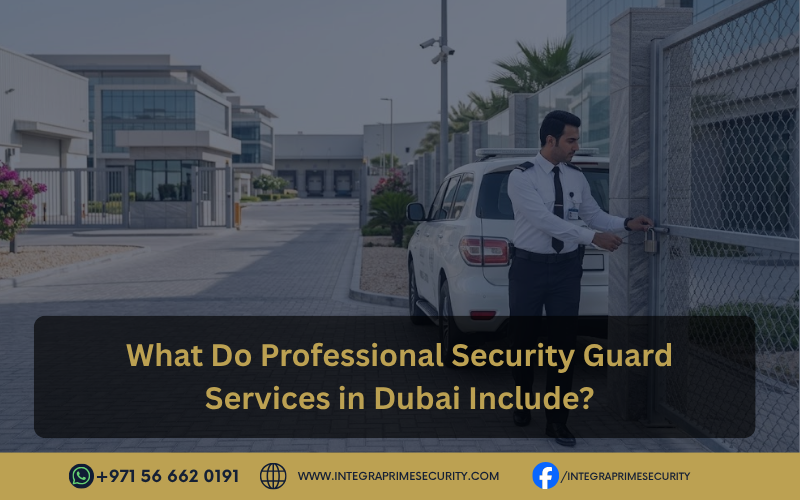
Professional security guard services in Dubai cover far more than simply placing a guard at the entrance of a building. Depending on the property, operating hours, risk level and security objectives, guarding can involve access control, patrols, visitor management, incident reporting, monitoring, emergency response and coordination with site management.
For businesses, property owners and facility managers, understanding what a professional guarding service actually includes makes it easier to choose the right level of protection. This guide explains the main elements of professional security guard services in Dubai, where they are commonly used, what security officers may be responsible for and what businesses should consider before appointing a provider.
Professional security guard services involve trained security personnel being assigned to protect people, property, premises and business operations.
The exact duties depend on the site and the agreed security plan. A commercial office, residential building, retail outlet, construction site and event venue can all require different approaches.
A professional guarding service may include:
The objective is not simply to have a visible security presence. Effective guarding combines deterrence, observation, prevention, communication and appropriate response.
For businesses considering external protection, [professional security guard services dubai] should be assessed according to the actual risks and operational requirements of the property rather than simply the number of guards required.
Security officers can have a wide range of responsibilities. Their duties should be clearly defined before deployment so that the security team understands what is expected at the site.
Access control is one of the most common responsibilities.
Security officers may monitor who enters and leaves a property, verify access permissions and help prevent unauthorised individuals from entering restricted areas.
Depending on the site, this can involve:
Good access control can help businesses maintain better awareness of activity around their premises.
Patrolling allows officers to inspect different areas of a property rather than remaining in one fixed position.
A patrol routine may cover:
Patrol frequency should be based on the property’s layout, operating hours, risk assessment and security requirements.
Busy commercial properties can have employees, contractors, delivery drivers, visitors and other authorised individuals arriving throughout the day.
Security personnel can help manage this movement by following site procedures for identification, access and visitor registration.
This can be particularly useful where several businesses operate from the same building or where contractors require controlled access to specific areas.
The responsibilities of a guarding team can extend beyond access control and patrols.
Professional officers should be able to record relevant incidents and observations clearly.
An incident report may document:
Accurate reporting gives management a clearer record of security-related events and can help identify recurring issues.
Security officers provide a physical presence that can help identify unusual behaviour, potential risks and changes around the premises.
This could include observing suspicious activity, unattended items, unauthorised access attempts or conditions that may create a security concern.
Where CCTV or other security technology is available, guarding personnel may also work alongside monitoring systems according to the site’s procedures.
Security teams may have an important role during emergencies by following established site procedures, communicating information and helping maintain controlled access.
Their responsibilities should be clearly defined in advance. Security officers are not a substitute for emergency services, specialist medical professionals or other appropriate authorities.
The response procedure should therefore explain when an incident needs to be escalated and who must be contacted.
Different types of properties can have very different security requirements.
Office buildings may require reception security, visitor management, access control, patrols and monitoring outside normal working hours.
The security approach can change depending on whether the building operates during the day, overnight or around the clock.
Retail environments can experience high visitor volumes and require security personnel to remain alert to theft risks, unauthorised access and incidents involving customers or staff.
Officers may also monitor entrances, exits and other designated areas.
Residential security can involve monitoring entrances, managing visitors, observing common areas and supporting building management with security procedures.
The priorities of a residential property are different from those of a warehouse or construction site, so the guarding plan should reflect the building’s specific requirements.
Construction sites and vacant buildings may contain equipment, materials, tools and other assets that need protection.
Security duties can include perimeter patrols, access control, checking vulnerable areas and reporting unusual activity.
Events often require security personnel to support controlled entry, crowd management, access restrictions and general site security.
The number and positioning of officers should be determined by the nature and scale of the event and its operational requirements.
Physical guarding and security monitoring are related but different approaches.
| Security Guarding | Security Monitoring |
| Provides a physical presence on site | Uses cameras or monitoring systems |
| Can control access directly | Can identify activity remotely |
| Can conduct physical patrols | Can monitor multiple areas through technology |
| Can communicate with people on site | Can escalate detected incidents |
| Suitable for properties requiring physical presence | Useful where remote observation is appropriate |
Many modern security strategies combine physical personnel with technology. The right approach depends on the property, risk profile and available systems.
For readers researching the fundamentals behind this service, understanding What Is Security Guarding can provide useful context about the role of professional guarding and how it fits into a wider security strategy.
Choosing a security company should begin with the property’s actual requirements rather than simply looking for the lowest quoted price.
Consider the following factors.
An office, warehouse, retail outlet, residential building and construction site can have completely different security requirements.
Determine whether security is required during business hours, overnight, weekends or continuously.
The number of entrances, exits, gates and restricted areas can influence the number and positioning of officers required.
Consider the assets being protected, previous incidents, unauthorised access concerns, visitor volumes and other relevant risks.
Ask how officers communicate with site management and how incidents, patrols and unusual observations are documented.
Find out how the provider supervises deployed officers and manages issues such as absence, performance and operational changes.
If the property already uses CCTV, access control or other technology, establish how the guarding team will work alongside those systems.
A security officer is often one of the first people a visitor encounters when entering a property.
Professional conduct therefore matters alongside security awareness.
A well-managed guarding operation should emphasise:
Security is ultimately a people-based service. Technology can support officers, but effective communication, observation and decision-making remain important parts of physical security.
A suitable guarding arrangement should be based on the individual site.
A typical planning process may involve:
1. Understanding the property
The provider reviews the building, site layout, entrances, vulnerable areas and operating environment.
2. Identifying security requirements
The business explains its concerns, operating hours, access arrangements and important assets.
3. Defining officer responsibilities
Specific duties such as access control, patrols, visitor management and reporting are established.
4. Establishing procedures
The security team receives clear instructions for routine duties and escalation of incidents.
5. Deploying the appropriate personnel
Officers are assigned according to the agreed operational requirements.
6. Reviewing performance
Security arrangements should be reviewed when circumstances, site operations or security requirements change.
This approach is generally more effective than treating every property as though it requires exactly the same guarding model.
Businesses can sometimes focus too heavily on the hourly cost of a security officer without considering the wider service.
Common mistakes include:
A professional security provider should be able to discuss the operational requirements and explain how the proposed service addresses them.
Before appointing a provider, businesses can ask:
These questions help move the discussion away from simply comparing prices and towards evaluating the quality and suitability of the service.
There is no single guarding model that is appropriate for every property in Dubai.
A small office may require a different arrangement from a large commercial facility, retail property, residential building or construction site. The right solution depends on factors such as property size, access points, operating hours, assets, visitor numbers and identified risks.
For businesses considering a professional provider, the most useful starting point is a clear understanding of what needs to be protected and what the security team is expected to achieve.
Professional security guard services provide trained personnel to protect people, premises, assets and business operations. Duties can include access control, patrols, visitor management, monitoring, incident reporting and supporting established emergency procedures.
No. Depending on the agreed duties, officers can conduct patrols, monitor designated areas, manage visitors, oversee access points, report incidents and perform other site-specific security responsibilities.
Yes. Physical security personnel and CCTV monitoring can complement each other. Guards can provide an on-site presence while monitoring systems can provide additional visibility over designated areas.
There is no universal number. Requirements depend on factors such as property size, entrances, operating hours, site layout, security risks and the duties assigned to officers.
Consider the provider’s ability to understand your site’s requirements, define clear officer responsibilities, provide appropriate supervision, maintain communication and deliver consistent reporting and operational support.
Security guarding can be used across many property types, including offices, retail premises, residential buildings, construction sites, commercial facilities and events. The duties and deployment should be adapted to the individual property’s requirements.
How can we help you?
WhatsApp us