

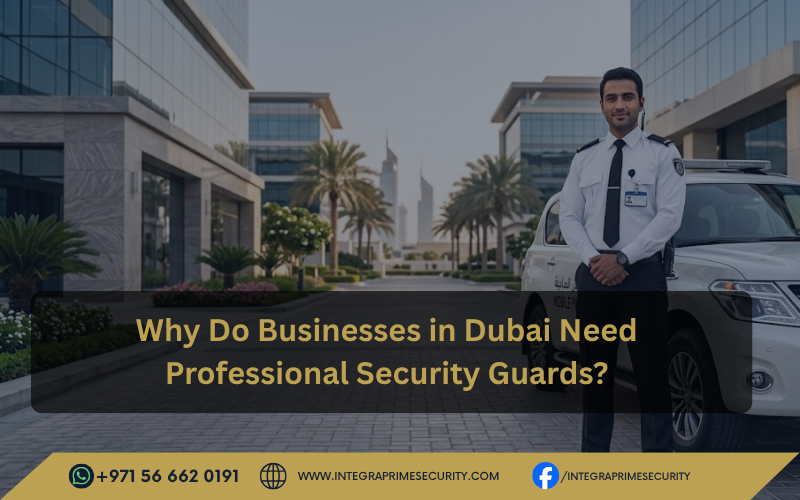
Dubai is a global business hub with a diverse commercial landscape that includes offices, retail stores, hotels, construction projects, warehouses, residential developments and large-scale events. With valuable assets, employees, customers and visitors present across these environments, businesses need practical measures to identify and manage security risks.
Professional security guard services Dubai businesses rely on can provide an important layer of physical protection. Unlike security technology that primarily detects, records or alerts, trained security personnel can observe situations in real time, control access, communicate with people on site and follow established procedures when security concerns arise.
For many organisations, professional security is not simply about preventing theft. It can also support access control, visitor management, incident reporting, emergency response, site protection, employee safety and overall risk management. When combined with CCTV, alarms, access control and other security technologies, security guards can form part of a more comprehensive security strategy.
Modern businesses face a variety of security challenges. These can range from unauthorised access and theft to vandalism, disputes, suspicious activity and emergencies.
The specific risks depend on the type of business, location, premises, operating hours and assets being protected.
For example, a retail store may be concerned about shoplifting and customer safety, while a construction site may need protection for machinery, materials and restricted areas. A corporate office may place greater emphasis on access control, visitor management and employee safety.
Professional security officers can provide a visible human presence that supports these different security requirements.
One of the simplest but important functions of a professional security officer is maintaining a visible presence.
A clearly identifiable security officer can help establish that a property is actively protected and monitored. This can discourage inappropriate behaviour and encourage employees, visitors and contractors to follow site procedures.
A security presence can be particularly valuable at:
The purpose is not simply to have someone standing at an entrance. Professional security should be integrated into the property’s wider security procedures and risk-management strategy.
Unauthorised access can create significant security risks for businesses.
Security officers can support access control by checking visitors, monitoring entrances and exits, verifying credentials where procedures require it, and directing visitors according to the organisation’s policies.
Depending on the premises, responsibilities may include:
Effective access control is particularly important for offices, warehouses, construction sites and facilities containing sensitive or valuable assets.
Businesses invest heavily in property, equipment, stock, vehicles, technology and other assets.
A professional security officer can help monitor these assets and identify suspicious behaviour or potential security concerns.
For example, at a warehouse, guards may monitor loading areas and vehicle movements. At a construction site, they may conduct patrols around equipment and materials. In retail environments, security personnel can support loss-prevention procedures.
This makes physical security an important component of broader asset protection and loss prevention.
Security is not only about protecting physical property.
Businesses also have a responsibility to consider the safety of employees, customers, contractors and visitors within their premises.
Security officers can provide an on-site point of contact when people have concerns or when unusual situations occur. Depending on their training and the employer’s procedures, they can help manage incidents, communicate with relevant personnel and escalate emergencies appropriately.
This can be particularly important in busy commercial environments where large numbers of people enter and leave the premises throughout the day.
Security officers are trained to remain alert to activity that may indicate a security concern.
This can include:
The role is not to make assumptions about people based on appearance or behaviour. Instead, professional security involves following established procedures, observing objectively, documenting relevant information and escalating concerns appropriately.
Patrolling allows security personnel to monitor areas that may not be continuously observed from a fixed security post.
Depending on the site, patrols may cover:
Regular patrols can help identify issues such as damaged fencing, unsecured doors, suspicious activity, safety concerns or other conditions requiring attention.
For larger sites, patrols can also complement CCTV monitoring by providing a physical presence in areas covered by cameras.
CCTV has become an important part of modern business security, but cameras alone cannot physically inspect a location or interact with people on the premises.
This is where human security and technology can work together.
A layered security strategy might include:
| Security Measure | Main Function |
|---|---|
| CCTV | Visual surveillance and recording |
| Security guards | Physical presence and on-site response |
| Access control | Managing authorised entry |
| Alarm systems | Alerting relevant personnel to specific events |
| Mobile patrols | Physical checks across larger or remote sites |
| Security lighting | Improving visibility around vulnerable areas |
| Incident reporting | Recording and communicating security events |
Combining these measures can help businesses create a more coordinated approach to security rather than relying on one technology or service.
Accurate incident reporting is an important part of professional security operations.
When an incident occurs, relevant information can be recorded and communicated to management or the appropriate authorities according to established procedures.
A security report may document details such as:
Good documentation can help businesses understand recurring risks and improve their security procedures over time.
Businesses need to be prepared for more than criminal activity.
Security personnel may also have a role in established emergency procedures involving incidents such as fire alarms, medical emergencies, building evacuations or other urgent situations.
Their exact responsibilities depend on their training, employer procedures and the nature of the site.
A security officer may help by:
Security guards should work within their training and assigned responsibilities rather than attempting to perform specialist emergency roles for which they are not qualified.
Dubai has a highly diverse commercial environment, so security requirements are not the same for every business.
Retail businesses may require security measures focused on loss prevention, customer safety, access monitoring and suspicious activity.
Construction projects may need protection for machinery, building materials, tools, temporary structures and site boundaries.
Corporate environments may place greater emphasis on access control, visitor management, reception security and employee safety.
Warehouses can require monitoring of loading bays, delivery areas, stock, vehicles and restricted sections.
Security personnel may support access management, visitor procedures, patrols and general site security.
Hotels have complex environments involving guests, employees, contractors, visitors and service providers. Security personnel can support access control, monitoring and incident management.
Large events can involve significant numbers of visitors and require coordinated security procedures covering entrances, crowd movement, restricted areas and emergency arrangements.
Effective business security should begin with understanding risk.
A professional approach considers factors such as:
What needs protection?
People, property, information, equipment, stock and infrastructure may all require different measures.
What are the potential threats?
The risks may include unauthorised access, theft, vandalism, disputes, emergencies or other site-specific concerns.
Where are the vulnerabilities?
Entrances, exits, loading areas, perimeter boundaries, storage locations and poorly monitored spaces may require additional attention.
When are risks highest?
Some businesses have different security requirements during operating hours, overnight periods, weekends or temporary shutdowns.
This type of assessment helps businesses determine whether they require security guards, mobile patrols, CCTV monitoring, access control or a combination of different measures.
Hiring security personnel is not simply about placing an individual at a property.
Professional security operations should be based on appropriate training, clear responsibilities, site procedures and effective communication.
Important qualities can include:
Businesses should also ensure that security arrangements meet applicable UAE requirements and that personnel are appropriately licensed or authorised where required.
Security guards remain important, but technology is changing how physical security is delivered.
Modern security strategies may combine officers with:
Technology can help security teams obtain information more quickly, while trained personnel can provide human judgement, communication and physical presence.
The combination can create a layered security model in which different measures support one another.
For many businesses, professional security personnel can provide several practical benefits:
The exact benefits depend on how security services are designed and managed for the specific property.
Before selecting a security solution, businesses should consider their actual operational requirements rather than choosing a service based only on price.
Key questions include:
A professional security provider should be able to understand the site’s requirements and develop an appropriate security approach rather than applying exactly the same solution to every business.
Businesses in Dubai may use professional security guards to protect people, property and assets, control access, monitor premises, manage security incidents and support established emergency procedures.
Depending on the site and assigned duties, security guards may monitor entrances, conduct patrols, manage access, observe suspicious activity, maintain security records, assist with visitor management and report incidents.
Security guards provide a visible physical presence, monitor vulnerable areas, control access and follow site-specific security procedures. They can also work alongside CCTV, alarms and access-control systems.
Security guards can form part of a business’s theft-prevention strategy by monitoring premises, observing suspicious activity, controlling access and supporting established loss-prevention procedures.
Yes. Construction sites may require security to monitor entrances, boundaries, equipment, materials, vehicles and restricted areas, particularly outside normal working hours.
Yes. CCTV and physical security can complement each other. Cameras provide visual surveillance, while security officers can monitor the premises physically, follow procedures and respond appropriately to situations within their responsibilities.
Security personnel may be used across offices, retail stores, warehouses, construction sites, hotels, residential communities, industrial facilities, commercial properties and events.
Security guards are generally assigned to provide an on-site security presence, while mobile patrol officers travel between locations or conduct scheduled site checks. Businesses may use either service or combine both depending on their security requirements.
There is no universal number. Requirements can depend on the size of the property, number of entrances, operating hours, risk profile, site layout and the duties assigned to security personnel.
Businesses should consider the provider’s experience, personnel, training, operational procedures, supervision, communication processes and ability to design security arrangements around the specific requirements of the property.
Security arrangements can be structured around the operating requirements of a business, including coverage outside normal working hours where required. The number of personnel and shift arrangements depend on the site and agreed security plan.
CCTV and security guards perform different functions. CCTV provides surveillance and recording, while security officers provide a physical presence and can carry out assigned on-site duties. A layered approach combining appropriate technologies and personnel can provide broader security coverage.
How can we help you?
WhatsApp us