

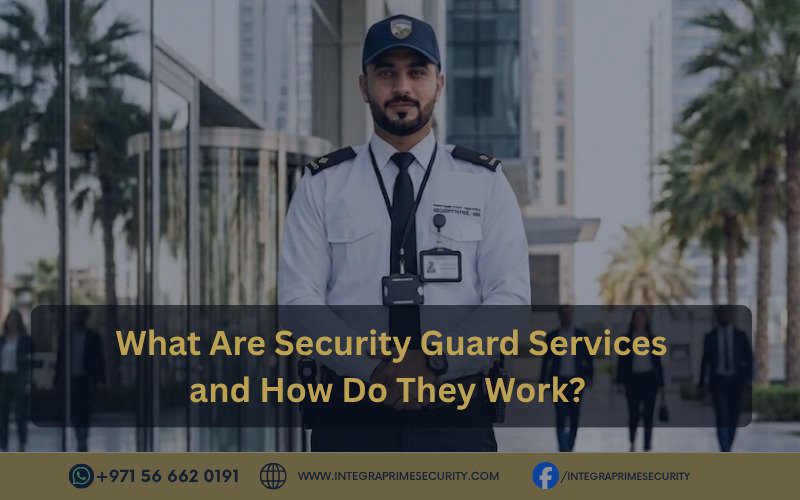
Security guard services provide trained security personnel to help protect people, property, premises, assets and business operations. Unlike security systems that rely primarily on technology, guarding services provide a physical security presence capable of observing activity, controlling access, identifying potential risks and responding according to established procedures.
Businesses use security guards in many different environments, including offices, retail premises, construction sites, residential developments, warehouses, industrial facilities, events and commercial properties.
But what exactly do security guards do, and how does a professional guarding service operate?
This guide explains how security guard services work, their common responsibilities, where they are used, how they integrate with technology, and what businesses should consider when selecting a security provider.
Security guard services are organised security operations in which trained security personnel are assigned to protect a particular location, property, event, organisation or group of people.
Depending on the requirements of a site, guards may work at fixed posts, conduct regular patrols, control entrances and exits, monitor activity, manage visitors, respond to incidents or support emergency procedures.
The purpose is not simply to have someone present at a building. Effective guarding is based on a combination of prevention, observation, communication, access control, incident response and reporting.
A security company will normally assess the environment and develop procedures based on factors such as:
This site-specific approach allows security personnel to perform duties that are relevant to the actual risks and operational needs of a premises.
The responsibilities of a security officer vary according to the site and assignment. A guard working in an office building may have very different responsibilities from one protecting a construction site or managing security at an event.
However, several duties are common across the private security industry.
Access control is one of the most important functions of physical security.
Security guards may monitor entrances and exits, check identification, verify authorised personnel and help prevent unauthorised access.
At some sites, this may involve:
The exact procedure depends on the organisation’s security protocols and access control systems.
Security personnel can also manage the movement of visitors, contractors and suppliers.
A visitor management process may include recording arrival and departure times, confirming the purpose of a visit and directing visitors to the appropriate area.
This creates a more controlled environment while helping site management maintain awareness of who is present on the premises.
Patrolling allows guards to inspect different parts of a property rather than remaining at a single position.
Patrols may be conducted on foot or, where appropriate, as part of mobile patrol operations.
A patrol schedule can cover areas such as:
During a patrol, security personnel may look for signs of unauthorised access, damage, hazards, suspicious activity, unsecured doors or other conditions that require attention.
Security guards provide a human layer of surveillance that can complement CCTV and other monitoring technology.
Observation involves remaining alert to activity around the premises and recognising situations that may require investigation or escalation.
A trained security officer may identify unusual behaviour, access attempts or environmental changes that automated systems cannot interpret effectively on their own.
Documentation is an important part of professional security operations.
When an incident occurs, the security officer may record relevant details such as:
Accurate incident reporting gives management a record of what happened and can help identify recurring risks or areas where security procedures should be improved.
Security personnel can also support established emergency procedures.
Depending on their role and training, guards may help manage access, alert responsible personnel, control movement around an affected area and communicate relevant information during an emergency.
The security team’s role should always operate within its training, assignment instructions and applicable procedures rather than replacing emergency services or specialist responders.
Physical security is particularly important where a business has valuable equipment, stock, machinery, materials or sensitive areas.
Guards can help protect these assets by controlling access, conducting patrols, monitoring activity and reporting concerns.
This can be especially relevant for warehouses, retail premises, industrial facilities and construction sites where equipment and materials may be distributed across large areas.
A professional guarding operation generally begins with understanding the site and its security requirements.
The process may begin with a security risk assessment.
This considers potential vulnerabilities, the site’s layout, access points, operating environment, valuable assets and existing security measures.
The objective is to understand what needs protection and where security controls may be required.
Following the assessment, a security provider can develop an operational plan.
This may define:
A well-designed plan gives security personnel clear responsibilities rather than relying on general instructions.
Trained security personnel are then assigned according to the site’s requirements.
Some businesses may require a single guard during specific operating hours, while larger or higher-risk premises may require multiple officers, supervisors, mobile patrols or a combination of services.
During each shift, guards follow the agreed procedures.
This can include monitoring entrances, conducting patrols, managing visitors, checking restricted areas and communicating with site management.
Security supervisors may also review operations and ensure that procedures are being followed consistently.
If an incident or unusual situation occurs, security personnel follow the relevant response and escalation procedures.
The incident is then documented so that management has a clear record.
Security requirements can change as businesses expand, premises are modified or new risks emerge.
For this reason, guarding arrangements should be reviewed periodically rather than treated as a fixed solution.
Security guarding services are used across a wide range of commercial and residential environments.
Office buildings may use guards for reception security, access control, visitor management, patrols and monitoring.
Security personnel can also provide a visible point of contact for employees, visitors and contractors.
Retail security focuses on protecting customers, employees, stock and property.
Depending on the environment, duties may include access monitoring, customer-area observation, loss prevention support and incident reporting.
Construction site security can help protect equipment, materials, tools and partially completed structures.
Guards may monitor gates, control contractor access, conduct perimeter patrols and report suspicious activity or site hazards.
Residential security services may be used in apartment developments, gated communities and other residential environments.
Typical duties can include access control, visitor management, patrols and monitoring of communal areas.
Event security involves managing security requirements around temporary or permanent venues.
Security personnel may assist with access points, crowd movement, restricted areas, staff entrances and incident response procedures.
Industrial facilities and warehouses may require controlled access, perimeter monitoring, vehicle checks and regular patrols.
Security procedures can be adapted to the site’s operating hours, equipment and access requirements.
Security guarding can be structured in several ways depending on the environment.
Manned guarding provides security officers at designated locations or across a site.
It can include access control, reception security, patrols, monitoring and incident reporting.
Static guards remain at a specific post for defined periods.
This is often suitable for entrances, reception areas, gates, control rooms or other locations where continuous physical presence is required.
Mobile patrol services involve security personnel travelling between designated locations or conducting scheduled inspections.
They can be useful for properties with large perimeters or multiple sites.
Event security is designed around the specific requirements of an event, venue and expected visitor activity.
Retail security focuses on maintaining a secure shopping environment while supporting loss prevention, customer safety and property protection.
Construction security is designed around risks associated with equipment, materials, site access and large or partially secured premises.
Modern security operations often combine people and technology rather than relying on one approach.
CCTV monitoring can provide continuous visual coverage of selected areas, while security officers can interpret situations, verify activity and take appropriate action according to their procedures.
For example, a CCTV system may identify movement near a restricted entrance. A security officer can assess the situation and follow the site’s established response process.
Technology can also support:
This combination of technology and trained personnel creates a more coordinated approach to security.
Businesses use security personnel for more than simply creating a visible deterrent.
A trained security presence can provide practical support across multiple parts of a property’s daily operation.
The presence of security officers can discourage some unauthorised or inappropriate activity.
Guards can observe circumstances directly and make decisions based on established procedures.
Security personnel can help ensure that access procedures are followed consistently.
Professional reporting provides management with information about incidents and recurring concerns.
Security teams can communicate with managers, facilities teams, employees, contractors and emergency responders when required.
For businesses considering professional security guard services Dubai, the most appropriate solution should be based on the property’s specific risks, operating environment and security objectives rather than simply the number of guards required.
The effectiveness of a guarding operation depends on several factors.
Security officers need appropriate training for their responsibilities, including communication, observation, reporting and relevant emergency procedures.
Guards should understand exactly what they are expected to do, when to escalate an incident and who should be contacted.
Communication between security personnel, supervisors and site management is essential for maintaining consistent operations.
A generic security routine may not address the particular risks of a warehouse, office, retail store or construction site.
Regular supervision can help maintain standards, identify operational issues and ensure procedures remain relevant.
Where appropriate, CCTV, access control and other systems can complement physical security and improve situational awareness.
Businesses should evaluate more than price when selecting a security provider.
Consider the following factors:
Start by identifying what needs protection and the risks affecting the site.
A security risk assessment can help establish appropriate requirements.
Look for a provider with experience in environments similar to your own, whether that means retail, construction, commercial property, residential premises or industrial sites.
Find out how security personnel are selected, trained, supervised and supported during assignments.
Ask how incidents, patrols and unusual observations are documented and communicated to management.
If your premises already uses CCTV or access control, establish how the guarding team will work alongside those systems.
A security provider should have clear communication channels between guards, supervisors and the client’s management team.
Your security requirements may change as the business grows. A provider should be capable of adapting its service when operating hours, locations or risks change.
Security guard services involve trained security personnel protecting people, property, assets and premises through duties such as access control, patrols, observation, visitor management, incident reporting and emergency procedures.
A security guard may control access, monitor activity, conduct site patrols, manage visitors, protect property, report incidents and follow established emergency and escalation procedures.
Security guarding provides a physical security presence, while CCTV monitoring uses cameras to observe designated areas. The two can work together, with guards responding to situations identified through monitoring systems.
Security guards are used by offices, retail businesses, warehouses, construction companies, industrial facilities, residential developments, event organisers and many other organisations that require physical security.
Security guards follow site-specific procedures based on the type of incident. This may involve observing and assessing the situation, notifying management, restricting access, documenting events and contacting emergency services where appropriate.
Businesses should consider their security risks, required coverage, guard training, supervision, reporting procedures, technology integration, communication arrangements and the provider’s experience in similar environments.
Yes, guarding services can be organised around different operating schedules, including daytime, overnight and 24-hour coverage, depending on the client’s requirements and agreed deployment plan.
Yes. Guards and CCTV systems can complement one another. Cameras provide visual monitoring, while trained security personnel can assess situations, follow procedures and respond to events requiring human intervention.
How can we help you?
WhatsApp us