

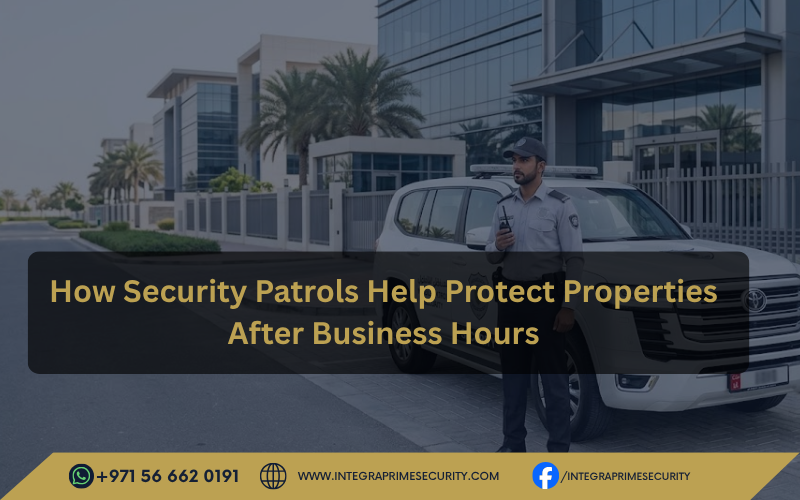
When a business closes at the end of the working day, normal activity around the property changes. Employees leave, customer traffic stops and management teams are no longer routinely present to notice unusual activity around entrances, car parks, storage areas or external boundaries.
However, the property itself continues to contain assets that may need protection. Stock, equipment, vehicles, technology, documents, building systems and other valuable items can remain on site overnight, while doors, gates, windows and other access points may become more important from a security perspective.
After-hours security is therefore not simply about having someone present at night. It is about understanding the property’s vulnerabilities, establishing appropriate inspection procedures and having a clear process for identifying and escalating security concerns when normal business activity has stopped.
For some businesses, CCTV and intruder alarms may provide important monitoring capabilities. For others, physical inspections may also be appropriate, particularly where there are vulnerable access points, large external areas, valuable assets or premises that are difficult for management teams to check regularly.
Mobile security patrols can provide that physical layer of oversight without necessarily requiring a security officer to remain permanently at the property. A patrol officer can visit at agreed times, inspect specified areas and report concerns according to the property’s security plan.
The role of patrol security services is therefore broader than simply driving past a building. Depending on the agreed service, officers may carry out external and internal checks, examine access points, identify visible signs of intrusion or damage, respond to specified alerts and document the condition of the property after business hours.
Security considerations can change significantly once a business closes. The reduction in normal human activity means there may be fewer people available to observe what is happening around the premises.
Potential concerns can include:
This does not mean that every property faces the same level of risk. A small office in a managed commercial building may have different requirements from a warehouse with extensive external storage, while a construction site may have completely different access and perimeter considerations.
Property type, location, operating hours, surrounding environment, existing security systems, previous incidents and the value of assets can all influence the appropriate approach.
A security risk assessment can help businesses identify vulnerable areas and determine whether mobile patrols, static security, CCTV, alarms, access control or a combination of measures is appropriate.
A security patrol involves a security officer physically attending a property to carry out agreed checks and observations. With mobile patrol security, officers can visit one or multiple properties during a shift rather than remaining permanently stationed at a single location.
Patrols can be scheduled according to the client’s requirements. In some circumstances, varied patrol timings may also be used where appropriate, helping avoid a completely predictable routine.
A patrol may involve:
The precise patrol instructions should be developed around the individual property. An officer attending a warehouse may need to inspect loading bays and external storage, while an office building may require greater attention to entrances, car parks and service areas.
Mobile patrols are also different from permanently stationed security guards. A static officer provides continuous on-site presence during the contracted period, whereas a mobile patrol service provides periodic physical attendance according to an agreed schedule.
A professional patrol should follow a clear process rather than simply involve an informal drive around the property.
The officer arrives at the designated site and follows the agreed access procedure. This may involve a secure entrance, key holding arrangement, access code or other authorised method.
The officer should be aware of any specific site instructions before beginning the inspection.
The officer may check the site’s external boundary, including fencing, gates, vehicle entrances, car parks and other accessible areas.
The purpose is to identify changes such as damaged fencing, open gates, signs of intrusion or unusual activity.
Doors, windows, shutters and other entrances can be inspected for signs of damage or unauthorised access.
Particular attention may be given to less visible entrances, loading areas and other locations identified during the property’s risk assessment.
Where authorised, officers may inspect designated internal areas or other locations identified within the patrol instructions.
These could include storage areas, plant rooms, corridors, equipment areas or other vulnerable parts of the premises.
Officers can look for suspicious activity, unusual vehicles, people on site without apparent authorisation or other circumstances that require further investigation.
They should follow the agreed procedure rather than making assumptions about an individual or situation.
Broken windows, damaged doors, forced locks, graffiti and other visible signs of intrusion can be documented.
A patrol can also identify changes to the property that may require attention from facilities management or the property owner.
If an incident is discovered, the officer follows the agreed escalation procedure. Depending on the circumstances, this may involve contacting a nominated client representative, key holder, alarm response contact or emergency service.
A patrol report can record attendance, relevant observations and action taken. Clear documentation provides the property manager with a record of the inspection and any issues requiring follow-up.
The exact procedure will depend on the site, client instructions, access arrangements and agreed security service.
One of the practical advantages of mobile patrol security is the visible presence of security personnel at a property after normal operating hours.
A marked patrol vehicle or uniformed security officer can make it clear that a site is not being left completely without physical oversight. This can help deter opportunistic unwanted activity, although no patrol service can guarantee that criminal activity will not occur.
Regular visits can also reduce opportunities for problems to remain unnoticed. An officer may identify a damaged fence, open gate or broken window during a routine inspection and report it before the issue becomes a more significant security concern.
Where appropriate, patrol timing can vary rather than following an entirely predictable pattern. The suitability of this approach depends on the client’s requirements and the property’s risk assessment.
The objective is not to create an impression of permanent guarding where none exists. It is to provide a practical physical presence that forms part of a wider security strategy.
After-hours patrols can help identify a range of visible security concerns.
These may include:
Security officers are not a replacement for specialist emergency services, maintenance contractors or technical professionals. Their role is to identify relevant concerns, follow the agreed procedure and escalate incidents appropriately.
This distinction is important because a patrol may identify a water leak, electrical concern or fire-related issue, but resolving such a problem may require a specialist contractor or emergency service.
How Do Security Patrols Help Protect Properties in Dubai? The answer depends on the property, its operating hours, access arrangements, existing security systems and the specific risks identified through a site assessment.
Dubai contains a wide range of commercial and property environments, including offices, retail premises, warehouses, industrial facilities, construction projects, residential communities and large commercial developments. Each can have different requirements after business hours.
For example, a warehouse may require attention to loading areas and vehicle access, while a retail premises may need checks around entrances, shutters and external areas. A construction project may require perimeter inspections and checks around equipment and materials.
The same principle applies elsewhere in the UAE. Security planning should be based on the actual site rather than assumptions about a particular location.
Physical patrols and security technology can provide different layers of protection.
CCTV can provide visibility across selected areas, while remote CCTV monitoring can allow authorised personnel to review activity away from the premises. Intruder alarms can also generate notifications when a potential security event is detected.
A physical patrol can complement these systems by providing on-site verification and action according to agreed procedures.
For example, a business may use:
CCTV and alarm systems can detect or alert to potential events, while a physical patrol can provide on-site verification and response according to agreed procedures.
However, the presence of an alarm does not automatically mean that a patrol officer will attend. Businesses should establish exactly what alarm response is included within their security contract.
Similarly, CCTV coverage may not reveal every physical issue. A patrol officer can identify a damaged gate, broken lock or other condition that may not be obvious from a camera feed.
Mobile patrols can be considered for many different property types, although the appropriate service will depend on the individual site’s requirements.
Offices can contain computers, documents, equipment and building infrastructure after employees have left. Patrols may focus on entrances, car parks, service areas and other vulnerable locations.
Retail businesses may have stock, display equipment, shutters, delivery areas and multiple access points. After-hours inspections can provide additional physical oversight once the premises has closed.
Warehouses may contain valuable stock and have large loading areas, vehicle entrances and external boundaries. Patrol routes can be designed around the site’s particular vulnerabilities.
Industrial premises may cover substantial areas and contain machinery, vehicles, equipment or materials. Perimeter checks can therefore form an important part of the patrol instructions.
Construction sites can change frequently and may contain plant, tools, materials and partially completed structures. Patrols can complement fencing, CCTV, lighting and controlled access arrangements.
Residential developments and communities may use security patrols to inspect communal areas, vehicle entrances, access points and other designated locations outside normal management hours.
Unoccupied buildings have less natural human oversight, making regular physical inspections potentially useful. Patrols can check for signs of intrusion, damage or unauthorised occupation according to the agreed site procedure.
There is no single patrol frequency that is suitable for every property.
A suitable schedule may depend on:
A smaller commercial property with strong access control and CCTV may have different requirements from a large industrial facility with multiple entrances and extensive external areas.
Businesses should therefore avoid selecting patrol frequency solely because a particular schedule is common elsewhere. A site-specific assessment can help establish what level of physical inspection is appropriate.
The schedule may also need to change. A business undergoing refurbishment, expanding its storage area or experiencing a change in operating hours may require its security arrangements to be reviewed.
Mobile patrols and static security have different operational characteristics.
| Mobile Patrols | Static Security |
| Officers visit according to an agreed schedule | Officer remains at the designated property |
| Can cover multiple sites | Provides dedicated site presence |
| Useful for periodic physical checks | Suitable where continuous coverage is required |
| Can provide vehicle or foot inspections | Provides ongoing observation |
| Patrol frequency can be adapted | Continuous manned coverage during contracted hours |
Neither approach is automatically appropriate for every property.
A business that requires constant observation of a sensitive entrance may consider static security, while a property that primarily requires regular physical checks may consider mobile patrols.
In some circumstances, businesses may also use both. For example, static security could cover a main facility while mobile patrols provide additional checks around wider premises or associated locations.
Key holding can form an important part of an after-hours security arrangement where authorised officers need controlled access to a property.
A typical process may involve a security company holding authorised keys or access credentials and using them according to an agreed procedure.
Where alarm response is included, an activation may trigger notification to the relevant response team. The responding officer can attend the property, assess the visible circumstances and follow the agreed escalation procedure.
Depending on the incident, this may involve:
The exact response depends on the service agreement, property instructions and circumstances of the incident. Businesses should establish these procedures before an incident occurs.
Selecting a provider should involve more than comparing patrol prices. Businesses need to understand how the service will operate in practice.
Look for a provider that understands the types of properties and environments relevant to your business.
The patrol plan should reflect the actual property, including access points, vulnerable areas and existing security systems.
The provider should be able to explain what officers will check and how patrols will be documented.
Ask how patrol reports and incidents are recorded and communicated to clients.
Where access credentials are required, establish how keys or other access arrangements are controlled.
Clarify what happens if an officer discovers damage, unauthorised access or another security concern.
Businesses should ensure that personnel and services meet any applicable UAE regulatory requirements. Where a particular activity is subject to requirements administered by bodies such as the Security Industry Regulatory Agency (SIRA), the specific service and jurisdiction should be considered rather than making broad assumptions about licensing.
The agreement should explain patrol frequency, inspection areas, reporting, response arrangements, exclusions and client responsibilities.
A practical security plan can help businesses establish clear responsibilities and reduce uncertainty when premises close.
Review entrances, windows, gates, loading areas, storage locations, car parks and other accessible parts of the property.
Ensure doors, shutters, gates and other access points are secured appropriately at the end of the working day.
Review fencing, walls, gates and vehicle entrances for weaknesses or damage.
Consider whether entrances, boundaries, car parks and other vulnerable areas have suitable lighting.
Check whether cameras provide useful coverage of important areas and whether monitoring arrangements are appropriate.
Confirm how intruder alarms operate and who receives notifications.
Keep keys and access credentials controlled and ensure authorised personnel understand the access procedure.
Consider whether regular mobile patrols would add useful physical oversight and what areas officers should inspect.
Maintain current details for property managers, facilities managers, key holders and other nominated contacts.
Security requirements can change when a business changes its premises, operating hours, assets, access arrangements or technology. Regular reviews help keep the security plan relevant.
Security patrol services involve security officers visiting designated properties to carry out planned physical checks. Depending on the agreed service, patrols may include vehicle or foot inspections, perimeter checks, access-point inspections, incident identification and reporting. Patrol frequency and procedures should be tailored to the property’s risk profile, operating requirements and client instructions.
After business hours, there may be fewer employees, customers or managers present to notice unusual activity. Security patrols can provide a visible physical presence and regular checks of the premises. They can help identify issues such as damaged doors, open gates, suspicious activity or signs of intrusion and ensure that relevant concerns are reported through the agreed procedure.
A mobile security patrol can check areas specified within the site’s patrol instructions. These may include external boundaries, gates, doors, windows, car parks, loading areas and other vulnerable points. Where authorised, officers may also inspect designated internal areas. The exact checks depend on the property’s layout, risk assessment, client instructions and access arrangements.
There is no standard frequency suitable for every business. Patrol schedules can depend on property size, location, operating hours, asset value, previous incidents, access points, existing CCTV and alarm systems, and the site’s overall risk profile. A site-specific assessment can help determine an appropriate schedule, which may be reviewed when circumstances change.
Yes. CCTV and physical patrols can provide complementary security measures. CCTV can monitor selected areas and generate alerts, while a patrol officer can physically attend the property where the agreed service includes response. Other measures such as access control, intruder alarms, lighting and perimeter protection can also form part of a layered security strategy.
Mobile patrols can be considered for offices, retail premises, warehouses, industrial facilities, construction sites, residential communities, commercial developments and vacant properties. The suitability of the service depends on the property’s individual circumstances. Businesses should consider the site’s vulnerabilities, access arrangements, operating hours and existing security systems before determining the appropriate patrol arrangement.
A mobile patrol officer visits a property periodically according to an agreed schedule, while a static security officer remains at a designated location during the contracted period. Mobile patrols can provide flexible physical checks across multiple properties, whereas static security provides continuous on-site presence. The appropriate option depends on the property’s security requirements.
They can where alarm response is specifically included within the agreed service. Businesses should confirm the response procedure before entering into a contract because a mobile patrol service does not automatically include every type of alarm response. The agreement should explain who attends, how access is managed, who is contacted and what actions the responding officer is authorised to take.
How can we help you?
WhatsApp us