

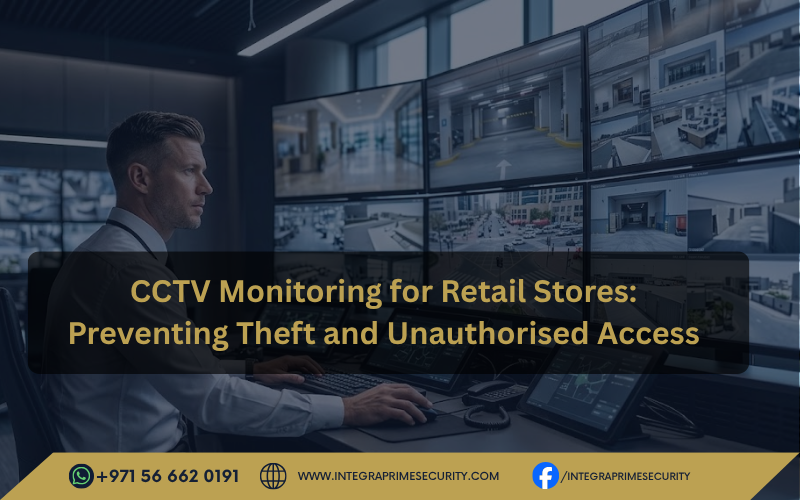
Retail environments can face a range of security challenges throughout the trading day, from shoplifting and internal theft to unauthorised access, suspicious behaviour and incidents around stockrooms or delivery areas. Supermarkets, fashion retailers, electronics stores, luxury shops, convenience stores and shopping centres may also have different security priorities depending on their layout, opening hours, merchandise and customer traffic.
CCTV can provide an important layer of visibility across these environments. However, there is a significant difference between cameras that simply record footage and a service where trained personnel actively monitor video and assess security alerts. Where the service is designed for continuous oversight, 24/7 live cctv monitoring can provide an additional level of visibility beyond reviewing recordings after an incident has already occurred. This article explains how retail CCTV monitoring works, how it can support theft and unauthorised access detection, and how it can complement wider security measures across Dubai and the UAE.
CCTV monitoring involves using security cameras to observe selected areas of a retail environment, either through recorded footage, live viewing, or a combination of both.
A typical retail CCTV monitoring arrangement can involve:
The exact configuration varies between systems and providers.
A recording-only CCTV system captures video that can be reviewed later. This can be valuable for investigating suspected shoplifting, internal theft, property damage or access incidents.
Actively monitored CCTV adds another layer. Where remote monitoring is included, trained operators can review live or triggered video and assess activity while it is taking place.
For example, a camera might capture movement around a restricted stockroom entrance after closing. With recording-only CCTV, the footage may be discovered during a later review. With active monitoring, the alert may be assessed as it occurs and handled according to the retailer’s agreed security procedure.
This does not mean that every alert represents an incident or that every CCTV system provides live monitoring. The capabilities depend on the equipment, monitoring arrangement, operating hours and service agreement.
Retail security involves more than monitoring the sales floor. Different parts of a store can present different operational and security considerations.
Potential risks include:
A convenience store may have particular concerns around entrances, tills and high-value products, while an electronics retailer may need stronger visibility around expensive merchandise and stockrooms. A supermarket can have a much larger footprint, with entrances, exits, aisles, loading areas, staff facilities and external areas all requiring different considerations.
Shopping centres also introduce another layer of complexity because individual retailers operate within a larger commercial environment. Store-level CCTV may need to complement wider security arrangements covering common areas, car parks and shared access routes.
Effective CCTV planning therefore starts with identifying where security visibility is actually required rather than installing cameras indiscriminately.
Visible security cameras can contribute to a retailer’s overall loss prevention strategy by making surveillance more apparent.
Customers and employees may be aware that key areas are monitored, while potential offenders may recognise that activity around entrances, merchandise and restricted areas is being observed.
Camera positioning can be particularly relevant around:
CCTV should not be treated as a guarantee against shoplifting or theft. Retailers typically achieve stronger security coverage by combining video surveillance with other measures such as security personnel, electronic article surveillance, access control, staff procedures and appropriate store design.
Camera placement is also important. A camera positioned poorly may leave a blind spot, capture an obstructed view or provide insufficient detail for the intended purpose.
The objective is to identify areas where CCTV can provide meaningful visibility and integrate it with the retailer’s wider loss prevention process.
Modern retail CCTV systems can offer more than straightforward video recording.
Depending on the equipment and configuration, systems may include features such as:
For example, a camera covering a staff-only corridor could be configured to identify movement outside expected conditions. Similarly, cameras around an external entrance may generate an alert when movement occurs during an agreed monitoring period.
However, detection is not the same as confirming an incident.
A motion alert simply indicates that movement or another configured condition has been detected. It does not automatically establish that shoplifting, trespassing or another security incident is taking place.
An operator may need to review the available footage, consider the context and determine whether further action is appropriate.
Video analytics capabilities also vary considerably. Retailers should not assume that artificial intelligence, facial recognition, people counting or advanced behavioural analytics are included in every CCTV monitoring system. The available features should be confirmed during the technology and service assessment.
One of the potential advantages of active CCTV monitoring is the connection between detection and a defined response process.
A general process may look like:
Detection → Assessment → Verification → Escalation → Response
For example, a camera alert may identify movement in a restricted area after closing. A monitoring operator can review the available footage and assess whether the activity appears consistent with normal operations.
If the activity requires further attention, the agreed escalation procedure may involve:
The exact process depends on the retailer’s security plan, monitoring agreement, site procedures and the circumstances of the incident.
CCTV monitoring also does not mean that police or emergency services are automatically dispatched following every alert. Verification, escalation and response arrangements should be clearly established in advance.
For retailers, this makes the response procedure just as important as the cameras themselves.
A well-designed CCTV strategy should consider how different areas of a store are used and what risks may be present.
Entrances and exits are important observation points because they connect the retail environment with external areas.
Cameras may provide visibility of people entering and leaving, access activity and unusual movement around doors. Positioning should be planned to provide useful footage while avoiding unnecessary coverage.
Sales-floor cameras can provide visibility around merchandise, customer areas and specific high-risk sections.
Retailers may use CCTV to support investigations involving suspected shoplifting, damage or unusual activity. Camera coverage should be planned around store layout, shelving and potential obstructions.
Cash-handling and payment areas can be sensitive locations. CCTV may help provide visibility around tills, self-checkouts and related areas where appropriate.
Retailers should also consider privacy and internal policies when deciding camera positioning and how footage is accessed.
Stockrooms are normally restricted areas and may contain significant quantities of merchandise.
CCTV can help monitor access points and support investigations where stock discrepancies or unauthorised entry are suspected.
Delivery zones may involve suppliers, employees, contractors and vehicles entering and leaving the premises.
CCTV can provide additional visibility around loading bays, service entrances and other access routes.
Depending on the property, external cameras may support monitoring around entrances, perimeter areas, service roads and car parks.
Coverage will depend on camera specification, positioning, lighting and the physical environment. Retailers should focus on identified security requirements rather than attempting to monitor every external area without a clear purpose.
Remote CCTV monitoring can connect a retail site to a security control room where trained monitoring operators assess relevant video feeds or alerts.
Depending on the service, operators may:
This can be particularly useful for retailers that need monitoring outside normal management hours or have limited security personnel on site.
There is also an operational difference between purchasing CCTV equipment and engaging a professional monitoring service. Equipment provides the technological infrastructure, while professional monitoring can add trained human assessment, procedures, reporting and escalation. This is one reason Why Businesses Choose Professional CCTV Monitoring Companies when they require more than passive video recording.
The appropriate model depends on the retailer’s requirements. Some businesses may only need recorded CCTV, while others may benefit from active monitoring during selected periods or around specific security risks.
Retail businesses operating several locations can face additional challenges when trying to maintain consistent security procedures.
These businesses may include:
Where available, centralised monitoring can provide a single operational point for reviewing alerts or managing video feeds from multiple locations.
Potential benefits can include:
Not every CCTV provider offers the same multi-site capabilities. Retailers should establish whether the proposed platform supports the number of locations required, how operators access individual sites and how incidents are reported and escalated.
For larger retail organisations, scalability should be considered at the beginning rather than only after additional stores are added.
CCTV is generally most effective when used as one part of a layered retail security strategy.
Other measures may include:
Each measure has a different role.
For example, CCTV can provide visual information, while a security officer can provide a physical presence on the premises. Access control can restrict entry into staff-only areas, while alarms can generate additional security alerts.
Mobile patrols may provide physical checks around larger retail properties or external areas, while key holding can support agreed response arrangements where appropriate.
The purpose of layered security is not to install every available technology. It is to combine suitable measures according to the property’s risks, operating model and security objectives.
Retail security in Dubai and the wider United Arab Emirates needs to be considered within the specific operating environment of the business.
Factors that can influence CCTV planning include:
A fashion retailer in a busy shopping centre may have different requirements from a standalone supermarket or electronics store. Similarly, luxury retail environments may have particular considerations around high-value merchandise and customer experience.
Businesses should also consider applicable local requirements relating to CCTV, privacy, data handling and security operations. The relevant rules can depend on the emirate, property type, business activity and circumstances.
The UAE’s official government portal identifies Federal Decree-Law No. 45 of 2021 concerning the Protection of Personal Data as part of the country’s data protection framework. Businesses should therefore avoid assuming that CCTV footage can be collected, stored or shared without considering applicable privacy and data protection responsibilities.
Retailers should verify current requirements relevant to their location and circumstances rather than relying on generic CCTV guidance.
Retail CCTV is normally deployed to support legitimate security and operational objectives, but surveillance should still be planned responsibly.
Businesses should consider:
Cameras should be positioned with a clear purpose. Retailers should avoid unnecessary surveillance of areas where monitoring is not relevant to the security objective.
Retail environments contain customers, employees, contractors and visitors. Camera use should take privacy considerations into account, particularly where sensitive areas or personal activities could be captured.
Access to recorded footage should be restricted to authorised personnel with a legitimate reason to view it.
Retailers should consider how recordings are stored, protected and transferred, particularly where remote monitoring or cloud-based systems are involved.
Businesses should establish appropriate retention practices rather than keeping recordings indefinitely without a defined purpose.
Depending on the circumstances and applicable requirements, appropriate notices may be relevant to inform people that CCTV surveillance is taking place.
UAE data protection requirements can depend on the organisation, jurisdiction, purpose of processing and other circumstances. Retailers should review applicable laws and regulations and obtain appropriate professional or legal advice where necessary. The UAE Government identifies personal data protection as a specific area of federal law, but a single generic CCTV rule should not be assumed to apply identically to every retail operation.
Selecting a monitoring service involves more than comparing camera specifications.
Retailers should consider the entire operational process, from detection through to incident reporting and response.
Important questions include:
Does the retailer require monitoring during trading hours, after closing, overnight, at weekends, or continuously?
Where is monitoring conducted, and what procedures are followed when an alert is generated?
Retailers should understand what training and procedures monitoring operators follow when assessing suspicious activity.
Does the proposed camera layout cover the areas that actually matter, including entrances, stockrooms, loading areas and identified high-risk locations?
How are alerts assessed before escalation? What happens when an alert turns out to be normal activity?
Is security guarding, mobile response or another physical response option available where required?
What information is provided following an incident, and how can management access relevant reports?
Can the monitoring arrangement accommodate additional stores if the business expands?
Can the proposed service work with existing cameras, alarms or other security systems where appropriate?
How are CCTV recordings protected, accessed and retained?
Who is responsible for service support, system issues and operational communication?
A practical assessment should consider both the technology and the people, procedures and response arrangements supporting it.
Before implementing or reviewing a retail CCTV monitoring arrangement, businesses can consider the following:
Regular review is important because retail environments are not static. New merchandise layouts, construction work, additional entrances, changes in operating hours or expansion into new locations can all affect security requirements.
Frequently Asked Questions About CCTV Monitoring for Retail Stores
CCTV monitoring for retail stores involves using security cameras to observe selected areas of a retail environment, either through recorded footage, live viewing or active remote monitoring. Where a monitoring service is included, trained operators may assess live or triggered video and follow agreed procedures when suspicious activity is identified. The exact capabilities depend on the CCTV equipment, monitoring arrangement and retailer’s security requirements.
CCTV can contribute to shoplifting prevention by providing visible surveillance around entrances, exits, merchandise areas and other identified risk points. Active monitoring may also allow suspicious activity to be assessed while it is happening. However, CCTV does not guarantee that shoplifting will be prevented. Retailers generally combine surveillance with security personnel, store procedures, electronic article surveillance, access controls and wider loss prevention measures.
CCTV recording captures video that can be reviewed after an incident. Live monitoring involves personnel actively viewing or assessing video feeds or alerts while activity occurs. A monitored system may therefore allow suspicious activity to be assessed sooner than a recording-only system. The distinction depends on the service arrangement, because not every CCTV installation includes live remote monitoring or continuous operator oversight.
Depending on the system, CCTV can support detection of movement or access in restricted areas. Motion detection, intrusion detection, virtual boundaries and other analytics may generate alerts when configured conditions occur. An alert does not automatically confirm that unauthorised access has taken place. Monitoring operators may need to assess the footage and follow an agreed escalation procedure before the event is treated as a security incident.
Yes, retail CCTV can be monitored remotely where the camera system, communications infrastructure and monitoring service support remote access. A security control room may receive live feeds or alerts and allow trained operators to assess selected activity. The precise arrangement varies between providers. Retailers should confirm monitoring hours, connectivity requirements, operator procedures, recording arrangements and response processes before selecting a remote CCTV monitoring service.
It can, depending on the technology platform and monitoring provider. Some services support centralised monitoring across multiple retail locations, allowing operators to manage selected feeds or alerts from different sites. This can support consistent procedures and central incident escalation. However, multi-site functionality varies, so retailers should confirm the number of locations supported, reporting capabilities, system compatibility and how incidents are managed across different stores.
Common areas for consideration include entrances, exits, sales floors, high-value merchandise areas, tills, self-checkouts, stockrooms, staff-only entrances, loading bays and selected external areas. The exact layout should be based on the retailer’s risk assessment and operational requirements. Cameras should not simply be installed everywhere; positioning should provide useful coverage while taking account of privacy, lighting, obstructions and the intended purpose of each camera.
Yes. CCTV monitoring and security guards can perform complementary roles. CCTV can provide visual information and help identify activity, while security officers can provide a physical presence and perform defined duties on site. Depending on the retailer’s requirements, monitored CCTV can also work alongside mobile patrols, access control and alarm systems. Combining measures can provide multiple layers of security rather than relying entirely on either technology or personnel.
Retailers should consider monitoring hours, control room procedures, operator training, camera coverage, alert verification, incident escalation, response arrangements, reporting, scalability, system compatibility and data security. Multi-site retailers should also consider whether the service can support additional locations. The most suitable arrangement depends on the retailer’s specific risks and operating model, so businesses should assess the complete monitoring and response process rather than focusing only on camera specifications.
Retailers should consider applicable UAE laws and regulations relating to privacy and personal data when operating CCTV. The UAE has a federal personal data protection framework, including Federal Decree-Law No. 45 of 2021. Practical considerations can include camera positioning, purpose, access to recordings, storage, retention and appropriate notices. Requirements can vary according to the organisation and circumstances, so businesses should obtain appropriate professional or legal guidance.
How can we help you?
WhatsApp us