

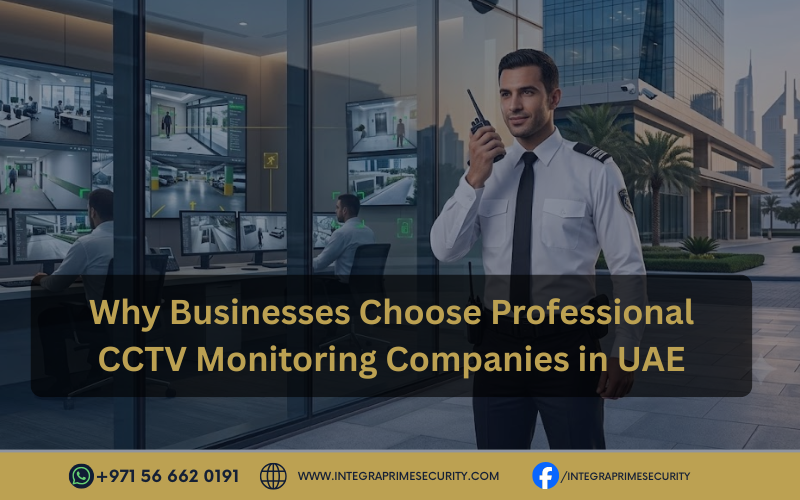
While installing CCTV cameras is an important first step, recording footage alone does not always provide immediate awareness of security incidents. If suspicious activity occurs outside business hours or in areas that are not actively monitored, valuable time may pass before someone reviews the footage. This delay can affect incident response, business continuity, and overall operational resilience.
Professional CCTV monitoring addresses this challenge by combining live surveillance, trained monitoring personnel, alarm verification, and structured security procedures. Instead of simply recording events, monitored CCTV systems enable businesses to identify potential security issues as they happen and take appropriate action based on predefined response plans.
Whether managing a shopping centre in Dubai, a logistics facility in Sharjah, a commercial office in Ajman, or a residential community in Ras Al Khaimah, businesses increasingly recognise that CCTV monitoring is most effective when integrated with broader physical security measures such as access control, security officers, mobile patrols, and risk assessments.
Professional CCTV monitoring companies provide continuous oversight of commercial surveillance systems through dedicated monitoring centres. Their role extends beyond watching security cameras—they help businesses verify alarms, identify suspicious activity, coordinate responses, and maintain accurate records of security events.
Rather than relying solely on recorded footage for later review, professional monitoring enables organisations to respond more proactively to potential risks.
Typical responsibilities include:
The exact scope of monitoring depends on the property’s operational requirements, security risks, and agreed response procedures.
One of the primary responsibilities of a CCTV monitoring company is observing live camera feeds from commercial properties.
Operators may monitor:
Unlike standalone CCTV systems that simply record footage, live monitoring allows trained professionals to assess situations in real time and respond according to agreed operational procedures.
Modern remote CCTV monitoring allows businesses to maintain security oversight without requiring staff to remain on-site at all times.
Secure monitoring centres can oversee multiple commercial locations simultaneously, making remote surveillance suitable for:
This flexibility helps organisations maintain consistent security coverage across different locations while supporting efficient security operations.
Alarm systems are valuable, but not every activation indicates a genuine security incident.
Professional monitoring teams verify alarms by reviewing live camera feeds before initiating agreed response procedures.
Operators may assess:
This verification process helps businesses respond appropriately while reducing unnecessary call-outs caused by false alarms.
Accurate documentation is an essential part of effective commercial security.
Professional monitoring companies typically record significant events such as:
These reports help businesses review security performance, identify trends, support investigations, and make informed decisions about future security improvements.
Every business has different operational requirements, so CCTV monitoring providers usually follow agreed escalation procedures developed with the client.
Depending on the situation, operators may:
Having clearly defined escalation procedures helps reduce delays during developing security situations.
Professional CCTV monitoring complements, rather than replaces, physical security personnel.
Monitoring operators often work alongside:
For example, if suspicious activity is detected at a commercial property in Dubai Silicon Oasis, monitoring operators can provide real-time information to on-site personnel, helping them respond more effectively while maintaining awareness of the wider site.
Although monitoring operators are not emergency responders, they play an important role during incidents by maintaining situational awareness and communicating relevant information.
Depending on the agreed procedures, operators may support emergency coordination by:
Businesses should ensure emergency procedures align with guidance issued by relevant authorities, including Dubai Police, the Security Industry Regulatory Agency (SIRA) where applicable, and the UAE Civil Defence.
Commercial security has evolved significantly in recent years. Businesses no longer rely solely on recorded CCTV footage to protect their premises. Instead, many organisations choose professional monitoring because it provides continuous oversight, faster incident awareness, and better support for overall security operations.
The following sections explain some of the key reasons businesses across the UAE choose professional CCTV monitoring.
Security risks do not stop when the working day ends. Many incidents involving theft, trespassing, vandalism, or unauthorised access occur during evenings, weekends, and public holidays when commercial premises may be unoccupied.
Professional 24/7 CCTV monitoring provides continuous observation of key areas such as:
Continuous monitoring helps businesses maintain visibility across their premises regardless of operating hours.
For example, a warehouse in Jebel Ali may require overnight monitoring of loading areas, while a corporate office in Business Bay may prioritise entrances and underground parking facilities outside normal working hours.
One of the biggest advantages of professional CCTV monitoring is the ability to identify unusual activity as it happens rather than discovering it hours later.
Examples include:
Early detection enables businesses to follow predefined response procedures more quickly and helps minimise operational disruption.
Instead of relying solely on recorded footage after an incident has occurred, live monitoring supports proactive security management.
False alarms can interrupt operations, consume valuable resources, and divert attention from genuine security concerns.
Professional CCTV monitoring helps reduce unnecessary responses through video verification. Before escalating an alarm, trained monitoring operators review live camera feeds to determine whether an alert appears genuine.
This process can help identify situations such as:
By distinguishing between genuine incidents and routine activity, businesses can make better-informed decisions while improving the efficiency of their overall security operations.
Business security is not only about safeguarding buildings and equipment. Creating a safe environment for employees, visitors, contractors, and customers is equally important.
Professional CCTV monitoring supports workplace safety by providing continuous visibility across key areas such as:
For example:
When unusual activity is detected, monitoring operators can follow agreed escalation procedures and notify the appropriate personnel, helping organisations respond promptly while maintaining a safe environment.
Security incidents can interrupt operations, delay deliveries, affect employee productivity, and impact customer confidence.
Professional CCTV monitoring contributes to business continuity by helping organisations:
For example, if unauthorised access is detected at a logistics facility in Jebel Ali, monitoring operators can verify the activity and notify authorised contacts before the issue escalates. Faster awareness allows businesses to activate response procedures and minimise disruption where possible.
A well-managed CCTV monitoring system does more than detect incidents—it also creates an accurate record of events.
Professional monitoring providers typically maintain detailed documentation covering:
This information helps businesses:
Recorded CCTV footage can also provide valuable context during post-incident reviews. Businesses should ensure video recordings are managed in accordance with applicable UAE regulations and internal data governance policies.
Modern commercial security is most effective when multiple security measures work together.
Professional CCTV monitoring can integrate with:
This layered approach creates a more comprehensive security strategy than relying on any single measure alone.
For example, if a monitored CCTV system detects suspicious activity around a warehouse perimeter in Sharjah, the monitoring centre can verify the event, notify security officers, coordinate a mobile patrol if appropriate, and record the incident for later review.
| Business Security Challenge | How Professional CCTV Monitoring Helps |
| Theft | Live monitoring and rapid incident verification |
| Vandalism | Real-time detection and recorded evidence |
| Unauthorised Access | Immediate alerts and coordinated response procedures |
| After-Hours Risks | Continuous 24/7 surveillance |
| Employee Safety | Ongoing monitoring and incident support |
| Operational Disruptions | Earlier awareness and informed decision-making |
Different industries face different operational and security challenges. Professional CCTV monitoring can be adapted to suit a wide range of commercial environments across the UAE.
Retail
Retail stores and shopping centres often experience high customer volumes, multiple access points, and valuable inventory.
Monitoring supports:
Warehouses
Warehouses require security for:
Professional monitoring improves visibility during evenings and outside operating hours.
Offices
Corporate offices benefit from monitoring:
This supports workplace safety while protecting confidential business assets.
Construction Sites
Construction sites often contain valuable equipment and materials.
Remote monitoring helps oversee:
Hotels
Hospitality businesses require security while maintaining a welcoming guest experience.
Monitoring can support:
Healthcare
Hospitals and healthcare facilities benefit from monitored surveillance around:
Manufacturing
Manufacturing plants often operate around the clock and contain valuable machinery.
Monitoring helps oversee:
Logistics
Distribution centres and logistics operations require continuous oversight of:
Education
Schools, colleges, and universities may use monitored CCTV to improve campus safety, manage visitor access, and support incident investigations when appropriate.
Commercial Buildings
Property managers responsible for office complexes and commercial developments often use monitored CCTV to oversee:
Because every organisation has unique operational requirements, CCTV monitoring strategies should always be tailored to the property’s size, layout, operating hours, and overall risk profile.
| Self-Monitoring | Professional CCTV Monitoring |
| Owner monitors alerts | Dedicated monitoring team |
| Limited availability | Continuous 24/7 monitoring |
| Slower incident awareness | Faster incident verification |
| Manual reporting | Professional incident reporting |
| Limited security expertise | Trained monitoring professionals |
| Standalone system | Integrated security approach |
Self-monitoring can be suitable for some smaller properties. However, businesses operating larger sites, multiple locations, or high-value facilities often benefit from professional monitoring because it provides continuous oversight, structured response procedures, and consistent operational support.
Rather than relying on an individual to monitor alerts throughout the day and night, dedicated monitoring teams provide ongoing surveillance that complements wider physical security measures.
Professional CCTV monitoring works best as one element of a comprehensive physical security strategy.
Businesses often combine monitored CCTV with:
Security Guards
Security officers provide a visible presence while responding to incidents identified through monitored CCTV.
Mobile Patrols
Mobile patrol security teams can investigate verified incidents identified through remote monitoring, particularly outside normal business hours.
Access Control
Electronic access control systems help regulate entry into restricted areas while CCTV monitoring provides visual oversight of access points.
Alarm Systems
Alarm monitoring and CCTV verification work together to improve response procedures and reduce false alarms.
Visitor Management
Monitoring reception areas and visitor entrances supports safer access management and improves operational awareness.
Risk Assessments
Regular risk assessments help businesses identify vulnerabilities and determine where monitored CCTV can provide the greatest value.
Security Consultancy
Professional security consultancy supports ongoing reviews of security arrangements, helping businesses adapt as risks, operations, and technology evolve.
By integrating multiple security measures, organisations create a layered approach that strengthens commercial property security, improves incident response, and supports long-term operational resilience.
Choosing a CCTV monitoring provider involves more than comparing equipment or pricing. Businesses should evaluate whether a provider can support their operational needs while delivering reliable monitoring and clear communication. When comparing live cctv monitoring services, consider the provider’s monitoring approach, response arrangements, communication processes and ability to support your site’s specific security requirements.
Key considerations include:
Industry Experience
Look for providers with experience supporting businesses similar to yours, whether in retail, logistics, manufacturing, hospitality, healthcare, or commercial property management.
Regulatory Compliance
Businesses should ensure that any security arrangements comply with applicable UAE regulations. Depending on the emirate and the type of premises, organisations may need to consider guidance issued by the Security Industry Regulatory Agency (SIRA), Dubai Police, or other relevant authorities.
Technology Capabilities
Consider whether the provider supports:
Technology should enhance, not replace, professional judgement and well-defined security procedures.
Monitoring Centre Operations
Understand how the monitoring centre operates, including:
Reporting Procedures
Ask how incidents are documented and communicated.
Useful reporting features may include:
Clear reporting helps businesses evaluate security performance and identify opportunities for improvement.
Customer Support and Scalability
As organisations grow, security requirements often change.
Choose a provider capable of supporting:
A scalable monitoring solution helps maintain consistent security as the business evolves.
Reputation and Security Expertise
Review customer feedback, operational experience, and professional expertise before selecting a provider.
Rather than relying solely on marketing claims, businesses should assess whether the provider demonstrates a practical understanding of commercial security operations and can tailor monitoring services to their specific environment.
Advances in surveillance technology continue to shape how businesses protect commercial properties.
Emerging developments include:
Artificial intelligence can help identify unusual patterns, reduce unnecessary alerts, and support faster event detection while keeping trained monitoring professionals involved in decision-making.
Modern systems increasingly prioritise meaningful security events over routine activity, improving operational efficiency.
Cloud technologies provide greater flexibility for storing, managing, and securely accessing recorded video across multiple business locations.
Advanced verification tools help monitoring operators assess alarms more accurately before initiating response procedures.
Businesses increasingly combine CCTV monitoring with access control, alarm systems, visitor management, and security operations platforms to create more connected and resilient security strategies.
Modern monitoring centres continue to expand their ability to oversee multiple sites from a central location, supporting businesses operating across Dubai, Abu Dhabi, Sharjah, and other emirates.
As technology evolves, successful CCTV monitoring will continue to depend on a balanced combination of trained personnel, effective operational procedures, and security solutions tailored to each organisation’s specific risks.
Professional CCTV monitoring companies remotely monitor live video feeds from commercial properties through a dedicated monitoring centre. Their responsibilities typically include live surveillance, alarm verification, incident reporting, video verification, and following agreed escalation procedures when suspicious activity is detected.
CCTV installation involves fitting cameras and related equipment at a property. CCTV monitoring is an ongoing service where trained professionals actively observe live footage, verify incidents, and coordinate responses where appropriate. Many businesses use both as part of a broader physical security strategy.
Yes. CCTV monitoring can be tailored to organisations of different sizes. Small offices, retail stores, restaurants, and local businesses may benefit from remote monitoring outside business hours, while larger organisations often require continuous monitoring across multiple locations.
Although no security solution can eliminate theft entirely, professional monitoring can help reduce opportunities for criminal activity by providing continuous surveillance, early detection of suspicious behaviour, faster incident verification, and improved coordination with on-site personnel or emergency services where appropriate.
In many cases, yes. Existing CCTV systems may be compatible with remote monitoring services, depending on the equipment, network infrastructure, image quality, and operational requirements. A professional assessment can determine whether upgrades or additional integration are needed.
Yes. Remote CCTV monitoring allows businesses to have their premises monitored from a secure monitoring centre without requiring personnel to remain on-site. This is particularly useful for warehouses, offices, logistics facilities, construction sites, hotels, and commercial properties that require security outside normal operating hours.
Professional CCTV monitoring is widely used across sectors including:
The most suitable monitoring solution depends on each organisation’s operational risks, property layout, and security objectives.
When selecting a provider, consider factors such as:
Businesses should also verify any certifications, licences, or regulatory requirements that apply to their sector or location before making a decision.
How can we help you?
WhatsApp us